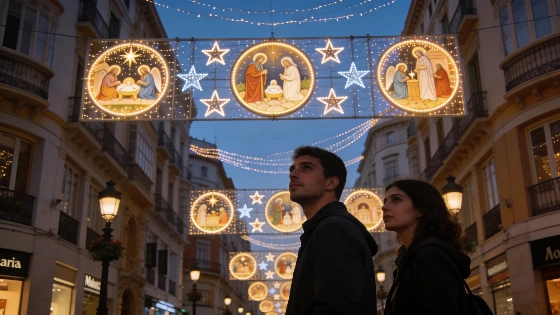
The lights will run from 17.30 to 1.00 from Sunday to Thursday. On Fridays and Saturdays, they will stay on until 2.00, as they will on 24, 25 and 31 December and 5 January. The citywide display is set to cover approximately 140 kilometres of streets in every district from 26 November 2026 through 6 January 2027.
The city’s launch event is set for 18.00 on Thursday, 26 November, on Passeig de Gràcia, between Rosselló and Diagonal. It will feature a large-scale stage and audiovisual production for all ages, with aerial dance set to an original soundtrack. The programme opens the city’s Christmas activities and marks the second edition of Barcelona Luces de Navidad, a public-participation programme built around its lighting design. The campaign has a reported budget of €4.6 million, with more than 65% financed through the city’s tourist tax, the Impost sobre les Estades en Establiments Turístics, known by its Catalan acronym, IEET, according to El Periódico.
District events will take place alongside the central ceremony. Ciutat Vella and L'Eixample will join the Passeig de Gràcia event, while Sants-Montjuïc and Les Corts plan a joint gathering at the junction of gran via de Carles III and avenida de Madrid.
Other district programmes include a performance by the Coro Moderno de la Cámara de Barcelona at the junction of Frederic Soler square and Sant Gervasi de Cassoles street in Sarrià-Sant Gervasi. In Gràcia, the Orfeó Gracienc and coral Roig Korai will perform at Pi i Margall promenade. Horta-Guinardó’s event is planned for Eivissa square with the Grupo Coral de Horta. In Nou Barris, traders from the Rambleta will host a ceremony at Pablo Iglesias street and Via Favència with the Coro del Ideal de Clavé. Sant Andreu’s event will be at Massadas square with choirs from the Escola Municipal de Música de Sant Andreu Mestre Pich Santasusana. Sant Martí will hold its event on the central section of Prim promenade with the Coral de la Fundación Vozes.
Two new locations will receive designer lighting: Prim promenade, with a proposal by Hey Studio, and Maragall promenade, designed by Jordi Canudes & Ingrid Picanyol. The city’s designer-lighting programme has previously included installations on Via Laietana and Plaça Catalunya. It has also featured work on Carrer Aragó and Gran Via de les Corts Catalanes. The programme will bring back the Galet, designed by Ramon Bigas, at 12 city markets, as well as Plaça del Rei and the junction of Rambla de Catalunya and Provença. The city describes the Galet’s return as a revival of Barcelona’s lighting heritage.
Barcelona’s earlier lighting plans, including the absence of a planned festive installation at Plaça de Catalunya, were covered in previous reporting. The city council has since said Plaça Catalunya will not remain in the dark during the Christmas period despite an encampment in the square, Ara reported.
A participatory project will turn drawings by 97 primary and secondary pupils into a projected light carpet around Mercado de la Marina. Its concept is described as 'la plaza como una hoja en blanco'. Windows at six landmark buildings will also be lit, among them Convento de Sant Agustí and Centro Cívico Sagrada Familia.
Light trails are planned across all ten districts, threading through commercial streets and past emblematic shops and illuminated fountains. The routes will also feature designs by local creators and design-school students. Market façades will receive lighting by La Invisible, with new displays at l'Abaceria in Gràcia and Montserrat in Nou Barris. The Clot and Vall d'Hebron markets will also have illuminated façades. Across the city, 255 light arches and 272 figures will be installed on around 20 streets, alongside illuminated totems and other Christmas-shaped structures.