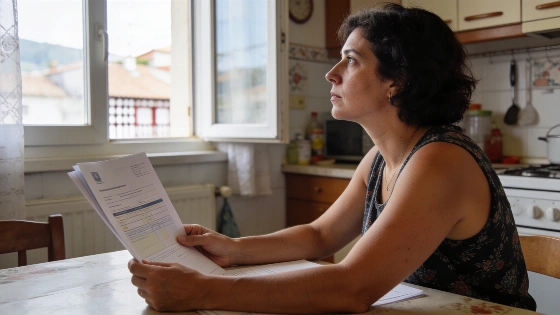
A domestic worker in the Basque Country has seen her unemployment benefit extended from 180 to 480 days after a court recognized nearly 1,000 days of prior service. The ruling challenges Spain’s previous exclusion of household employees from full jobless protection and could signal broader changes.
A domestic worker in the Basque Country has secured a dramatic extension of her unemployment benefit, after the Tribunal Superior de Justicia (TSJ) recognized 958 days of service that had previously been excluded from her claim. This decision, which is not yet final, increases her entitlement from 180 to 480 days of contributory unemployment aid—a rare reversal that could have implications for thousands of household employees across Spain.
The case centers on the period before October 2022, when domestic workers were not required to pay into Spain’s unemployment insurance system. The woman, who worked for three different employers between January 2020 and September 2022, initially had only 554 days of contributions recognized by the Servicio Público de Empleo Estatal (SEPE). This placed her in the lowest benefit bracket, granting just 180 days of support. However, the TSJ’s ruling added her 958 days of prior service, bringing her total to 1,512 days—enough to qualify for 480 days of unemployment benefit under SEPE’s tiered system.
Legal Shift on Domestic Work
Until late 2022, Spain’s domestic workers were excluded from unemployment insurance, a policy that disproportionately affected women. The initial court ruling sided with SEPE, arguing that days worked before the legal change could not count toward unemployment benefits. But the TSJ overturned this, citing a 2022 European Court of Justice decision that found Spain’s exclusion of domestic workers from jobless protection to be indirect gender discrimination, violating EU Directive 79/7.
Following this European ruling, Spain enacted Real Decreto-ley 16/2022, making unemployment contributions mandatory for domestic workers from October 2022 onward. However, the law did not automatically recognize earlier periods of service. The TSJ argued that continuing to exclude these days would perpetuate the very inequality condemned by the European court, and ordered them to be counted in this specific case. The ruling, issued in June 2026, is still open to appeal and does not yet set a binding precedent for all similar claims.
How the Benefit Calculation Changed
SEPE calculates unemployment benefit duration using a scale based on days contributed. With 554 recognized days, the worker fell into the 540–719 day bracket, qualifying for 180 days of aid. The TSJ’s inclusion of 958 additional days moved her into the 1,440–1,619 day bracket, granting 480 days of benefit. The ruling affects only the duration, not the monthly amount, which is calculated separately based on the worker’s regulatory base—typically 70% for the first 180 days, then 60% thereafter.
It’s important to note that the 300 extra days refer to the length of support, not a lump-sum payment. The financial impact depends on each worker’s individual contribution record and base salary.
Administrative Changes and Ongoing Limits
Even before this court decision, SEPE had begun to adapt its approach. In November 2025, following legal advice and union pressure, SEPE issued new guidance allowing periods of domestic work without unemployment contributions to be counted—within the six years prior to a claim—if the worker had no overlapping contributions from other jobs. However, if a domestic worker also contributed under the general regime during the same period, these days are not automatically included. This nuance was central to the Basque case, as the claimant had mixed employment records, making her situation more complex.
Each denied claim must now be reviewed in detail, considering the exact dates of service, any overlapping contributions, and whether those days have already been used for another benefit. The Basque ruling strengthens a growing legal trend in favor of domestic workers, but its broader impact will depend on future court decisions and administrative practice.
Practical Steps for Claiming Unemployment
For domestic workers in regions like Andalusia, the process remains governed by national rules. Applicants must first register as jobseekers with the regional employment service, then submit their claim to SEPE within 15 working days of their last day of work. Key requirements include being legally unemployed, having at least 360 eligible days within the past six years (not previously used for another benefit), and providing written notice from the employer. The minimum monthly benefit in 2026 is €560 for those without dependents, rising to €749 with children, while maximums range from €1,225 to €1,575 depending on family size.
Those with fewer than 360 days of contributions may qualify for a separate, means-tested subsidy. For more on how courts are shaping social protections for vulnerable groups, see this analysis of a French court’s intervention in a landlord-tenant dispute: French legal action halts eviction over excessive rent charges.
While the Basque ruling marks a significant step for domestic workers’ rights, its full impact will depend on whether higher courts uphold the decision and how SEPE applies these principles nationwide.