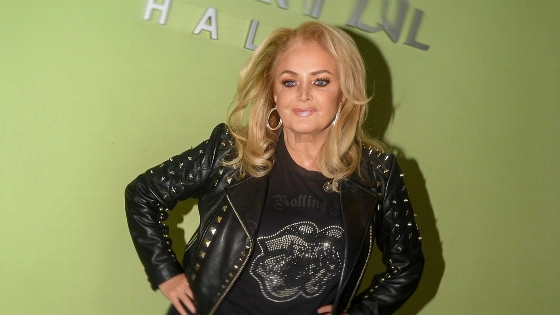
Her family said the Welsh singer Bonnie Tyler, whose distinctive raspy voice defined late 1970s and 1980s pop, died unexpectedly in a Portuguese hospital on 8 July 2026, aged 75. Her death came so of the illness for which she was being treated. Tyler had undergone emergency intestinal surgery in Portugal in May and spent about a month in a medically induced coma. On 15 June, her management said she was no longer in a coma but remained very unwell in intensive care. Her concerts through the end of August were cancelled or postponed where possible.
Tyler's impact on the international music scene was immediate and lasting. In Spain, her breakthrough came with “It’s a Heartache” in 1978, a song that topped sales charts during the country's transition period. Her global fame soared with “Total Eclipse of the Heart” in 1983: the dramatic ballad reached No. 1 on the Billboard Hot 100 and spent four weeks at the top. Its enigmatic video continues to spark discussion. Tyler was a Grammy and Brit Award nominee and was appointed a Member of the Order of the British Empire in 2023 for services to music.
Her career peak spanned roughly seven years, from the late 1970s to the mid-1980s. During this period, Tyler became a familiar face on Spanish television, particularly on the music show Aplauso, and regularly toured the country. She was especially popular at summer festivals, performing in places such as Fuengirola, Alicante and Mallorca. Her concerts featured signature hits including “It’s a Heartache,” “Total Eclipse of the Heart” and “Holding Out for a Hero,” which gained renewed popularity after its inclusion in Footloose and later Shrek 2. Tyler also covered songs by Creedence Clearwater Revival, the Bee Gees, Bryan Adams and Kiss, adding variety to her live performances.
Born Gaynor Hopkins in Skewen, Wales, Tyler was the youngest of six children in a working-class family. She left school early to pursue singing, performing in local bars where she met her future husband, Robert Sullivan. A talent scout encouraged her to move to London, where she began working with songwriter Ronnie Scott. Early in her career, surgery to remove vocal-cord nodules was followed by six weeks in which she was told not to sing, speak or whisper. Tyler later called that enforced silence “the hardest thing I’ve ever had to do.” Her first major success came with “It’s a Heartache” in 1977.
The 1980s brought international tours, chart-topping singles in the United States and appearances on major television programmes such as Top of the Pops. Her 1983 album Faster Than the Speed of Night further boosted her profile, and “Holding Out for a Hero” became another major hit. In 1987, Tyler collaborated with Mike Oldfield on “Islands,” which achieved moderate success in Spain. By the end of the decade, her commercial momentum had slowed. Her 1988 release “The Best” failed to make a impressive impact, before Tina Turner’s cover became a global hit the following year.
Although she moved out of the mainstream spotlight, Tyler continued performing extensively, especially across Europe. She often spoke of her working-class roots and her willingness to accept performance opportunities, particularly in countries where she felt appreciated. In 2013, she represented the United Kingdom at the Eurovision Song Contest in Malmö with “Believe in Me,” finishing 19th out of 26 entries. She retained a loyal audience in Scandinavia as well as a strong following in Spain. Her 2021 album, The Best Is Yet to Come, received positive reviews from music critics.
“Total Eclipse of the Heart” remains one of the most streamed songs from the 1980s, surpassing a billion plays on both Spotify and YouTube. Written by Jim Steinman and featuring members of Bruce Springsteen’s E Street Band, the track was originally intended for a musical adaptation of Nosferatu. Its theatrical style and Tyler’s passionate delivery have helped sustain its popularity. The music video, filmed in a former asylum in Surrey, added to the song’s mystique and continues to attract attention for its haunting visuals.
Tyler’s influence extended beyond her own recordings. Her ability to adapt to changing musical trends and her willingness to perform in varied settings kept her connected to audiences long after her commercial peak. Her story echoes that of other performers who maintained their artistry and stage presence well into later life, as seen in recent high-profile concerts by Van Morrison in Barcelona.
Tributes followed Tyler’s death in Britain and internationally. Prime Minister Keir Starmer described her as “one of Britain’s greatest.” A retrospective documentary about her career, produced by Sveriges Radio, drew on her autobiography Straight From the Heart, archival television and Eurovision material, as well as later interviews. Tyler’s career showed ability to recover and flexibility in the music industry. Her songs, especially “Total Eclipse of the Heart,” continue to resonate across generations, and her legacy is particularly strong in Spain, where she remained a beloved live performer and a symbol of a vibrant musical era.