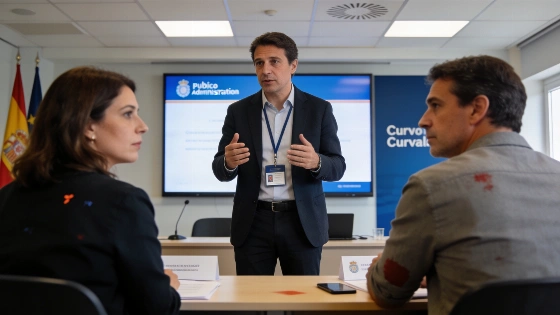
Agents of employment and local development will meet professionals from Canary Islands administrations at the Government’s Edificio de Usos Múltiples I in Santa Cruz de Tenerife. The Instituto Canario de Administración Pública (ICAP) has scheduled the sessions for 12 and 13 November 2026 to examine challenges facing the archipelago’s comarcas and share tools for local public policy.
The programme, titled ‘La Administración Pública ante el Bienestar Social y Económico de las Comarcas: formación’, comprises eight talks and two debate sessions over two mornings. The Portal de Noticias del Gobierno de Canarias says public bodies and businesses will contribute evidence, alongside social organisations with practical experience. ICAP director Gustavo Pérez says the aim is to give local development professionals reliable information and a space to coordinate across those sectors.
Thursday’s session will consider population ageing and social vulnerability before turning to mobility and the mismatch between job vacancies and applicants. October 2026 figures attributed to Spain’s Ministry of Labour and Social Economy put registered unemployment in the Canary Islands at 141,518, up 1,215 people, or 0.87%, from September but down 6,161, or 4.17%, year on year. Employers signed 67,040 contracts during the month, 2,604 fewer than in September and 3,405 fewer than a year earlier. Rafael Betancor Villalba, head of the Demographic Statistics Section at the Instituto Canario de Estadística (ISTAC), will speak on ‘Del dato a la decisión. El desafío del relevo en un territorio envejecido’.
Maitane Cabrera Primo, president of the Colegio Oficial de Trabajo Social de Santa Cruz de Tenerife, will address ‘La vulnerabilidad crítica de la persona no perceptora’. María Eulalia García Silva, fourth vice-president and island councillor for Mobility at the Cabildo de Tenerife, will examine mobility and quality of life in ‘Salud territorial: movilidad y tiempo de vida’.
Francisco Gorrín López of the Asociación Industrial de Canarias (ASINCA) will present experience from the Polígono de Güímar. Rut López Álvarez, coordinator of Barrios por el Empleo at the Fundación General de la Universidad de La Laguna, is also on the programme. The morning will end with a technical discussion of the gap between employment supply and demand in the comarcas. The wider October jobseeker total was 208,980, including 36,418 people registered as employed, among them fixed-discontinuous workers inactive or awaiting a new work period, and 9,453 subsidised seasonal agricultural workers who are counted separately from conventional unemployment. In 2026, the Canary Islands Employment Service also planned to fund 17 Alternating Training with Employment-Youth Guarantee projects, with €7,105,730.75 allocated to 255 unemployed people under 30, prioritising young people without formal training.
Friday’s programme turns to other factors affecting local wellbeing and economic development. Psychologists Alba Fernández Padrón and Edgar Chinea Gámez of ‘conSciencia’ will discuss family-work balance. Carlos Sabina Lugo, vice-president of FAUCA and secretary general of Zona Centro, will examine how local commerce and nearby products can help keep income within the comarcas.
Juan Luis Perdomo Falcón, employment, training and entrepreneurship coordinator at the Sociedad de Desarrollo de Santa Cruz de Tenerife, will explain the role of local development agencies in their labour markets. Island-level October figures varied: La Palma recorded 5,798 unemployed people, up 82 from September, while Lanzarote recorded 7,013, a monthly increase of 222 and 1.2% above October 2025. A second debate will close the day. The focus on professional training is separate from a Spain-Chile university initiative: leaders signed a cooperation statement at La Laguna on the 20th, covering training and shared capacity.
Attendance is free, but places are limited and registration is required through the form provided by the ICAP. The sessions will be recorded for later access through the institute’s media library. Attendees can submit questions to speakers using a QR code during the debates.