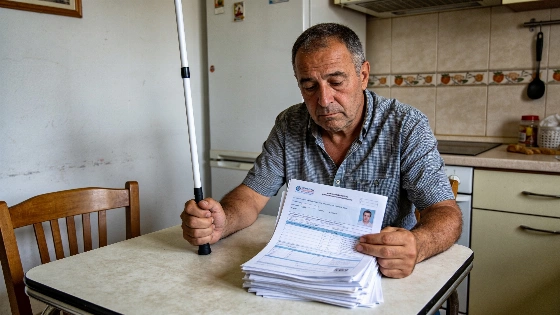
A Badajoz lottery vendor with a 92% certified disability has been denied permanent incapacity by the regional court. Judges ruled his conditions did not legally prevent him from working or require third-party assistance. The case exposes the strict legal thresholds for disability pensions in Spain.
A lottery seller for ONCE in Badajoz, officially recognized as 92% disabled, has been denied permanent incapacity by the Tribunal Superior de Justicia de Extremadura. The court delivered its decision in June, making it public in August. The ruling leaves the worker without the pension he sought and highlights how strict Spanish law is when it comes to these claims.
The main issue: the court found no evidence that the man’s severe visual impairment—glaucoma juvenil and amaurosis bilateral—or his diagnosed mixed adjustment disorder made him unable to work or manage daily life on his own. Judges noted that he lived alone and handled basic tasks independently, which weighed against his claim for both absolute and "gran incapacidad" status.
In Spain, the percentage of recognized disability alone does not entitle a person to a permanent incapacity pension; what matters is the actual ability to work and functional limitations.
His case began after his temporary incapacity benefit ended. The INSS started a review in April 2024. By June, the provincial office in Badajoz had rejected his application, stating that his medical conditions did not meet the legal definition of permanent incapacity. When his administrative appeal went unanswered, he took the case to court.
The Social Court No. 4 in Badajoz dismissed his claim in December 2025. The judge pointed out that the claimant’s blindness was already present when he joined ONCE, and that his psychological symptoms, though documented, did not stop him from doing his job adequately.
On appeal, the vendor argued that his condition had worsened, citing a major depressive disorder and risk of psychosis, and referenced a medical expert report. The TSJ, however, found his arguments lacking in procedure: he did not provide a clear alternative account of the facts or specify the medical evidence needed to overturn the lower court’s findings. Without this, the higher court had to rely on the original facts, which did not support a finding of total or absolute incapacity.
From September 1, 2026, the INSS switched all notifications regarding temporary and permanent incapacity to a digital-only format. This change means that decisions and requirements are now delivered through the electronic sede and are considered received after 10 days, which is crucial for claimants in similar cases.
Why doesn’t a 92% disability rating guarantee a pension? Spanish law separates disability percentages from the legal concept of incapacity. The CADEX rating, even when severe, is not enough by itself. The law requires proof of permanent, objectively serious losses that directly reduce or eliminate the ability to work. Only if pre-existing limitations worsen after starting work—and this is proven—can they be considered for incapacity status.
The court found no such worsening. For "gran incapacidad," the law requires proof that the person cannot perform essential acts—like dressing, moving, or eating—without help. For absolute incapacity, the standard is even higher: total inability to work in any job. The judges concluded that the claimant’s case did not meet these requirements.
He also claimed a violation of his right to effective judicial protection, arguing that the court had not properly considered his medical evidence. The TSJ rejected this, stating that the trial judge had explained why the expert’s conclusions were not accepted and that only clear, documented errors could justify overturning such assessments.
With the appeal rejected, the court confirmed the earlier ruling and did not impose costs, since the claimant qualified for free legal aid. The judgment allowed for a further appeal to the Supreme Court, but it is unclear whether the vendor pursued this option. The ruling applies only to this case and leaves open the possibility of a different outcome if new, more severe limitations are proven in the future.
This case shows how rigid the legal framework is for disability pensions in Spain. Even with a near-total disability rating, the burden remains on the claimant to prove not just a diagnosis, but actual functional incapacity. For many, the gap between administrative recognition of disability and the legal requirements for a pension is wider than expected—and, as this ruling shows, often impossible to bridge without detailed evidence and careful procedure.