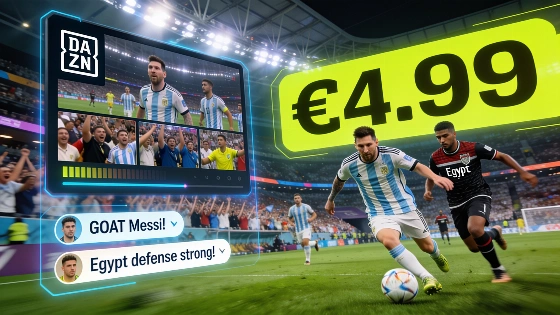
DAZN reduced the price of its World Cup coverage to €4.99 for access to all remaining matches as the tournament entered its decisive phase. The promotion accompanied a round-of-16 schedule featuring several high-profile knockout ties, with teams competing for places in the quarterfinals.
The package was presented as including every remaining match, with expert commentary and in-depth analysis. DAZN also listed match summaries among the included features. Its multipanel viewing technology lets viewers follow multiple games or angles at once, while FanZone offers a space for live chat and shared reactions. Information from DAZN’s description, the offer also included more than ten hours of daily programming.
Argentina met Egypt in Atlanta on 7 July 2026, with kick-off listed for 18:00 Basic European Summer Time. In the round-of-16 match, Argentina came back from two goals down to win 3-2 and advance to the quarterfinals. Switzerland and Colombia played later that day in Vancouver, with kick-off scheduled for 22:00 Basic European Summer Time. The match ended 0-0, and Switzerland advanced by winning the penalty shootout 4-3.
The results settled the next-opponent question: Switzerland advanced to face Argentina, not Colombia. The teams met in the quarterfinals in Kansas City the following Saturday, where Argentina won 3-1. The 2026 tournament ran from 11 June to 19 July, and the July fixtures formed part of the expanded competition’s knockout stage.
The Switzerland-Colombia clash drew particular attention, especially after Switzerland’s high-stakes encounters. A related analysis of Switzerland’s performance and ambitions can be found in this recent report on their knockout stage journey.
At the time of the promotion, DAZN’s €4.99 price gave viewers in Spain and elsewhere in Europe a lower-cost way to follow the remaining tournament matches. Its coverage paired live football with commentary, along with interactive features, as the field narrowed and the stakes rose.
DAZN has become a prominent sports-streaming player in Spain, where it has secured rights to major football events. Multipanel viewing and community features are designed to give viewers flexibility and interaction, reflecting broader competition among digital broadcasters over content and user experience.