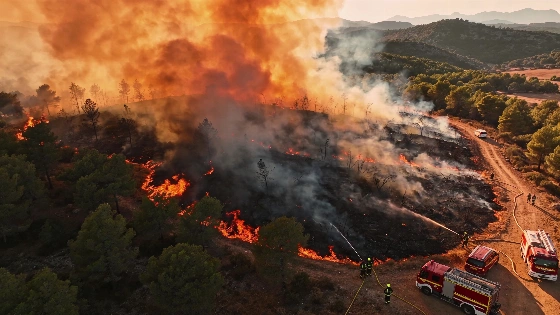
The wildfire that struck Los Gallardos in Almería in July 2026 initially left at least 12 people dead. The provisional toll later rose: October coverage reported 14 or 15 fatalities, as some injured victims died and others were identified. The fire affected Los Gallardos and neighboring Bédar, burning roughly 7,000 hectares. Canal Sur described it as the deadliest fire in Andalusia of the 21st century.
Reports gave different final death tolls. La Opinión de Málaga’s October account recorded 15 deaths in Los Gallardos, while other reporting put the figure at 14. The fire’s scale and mounting toll made it one of the defining disasters of Andalusia’s 2026 fire season, alongside the Niebla fire in Huelva. Residents were evacuated as flames spread into populated areas.
The cause of the Los Gallardos fire remained under investigation. RTVE reported that SEPRONA, the Guardia Civil’s environmental-protection service, was examining its origin. Investigators had not established a definitive ignition source or legal responsibility. The reported scale of the fire does not by itself determine how it started.
Andalusia’s wider fire season was also exceptional. La Opinión de Málaga reported 58,735 hectares burned across the region, while La Voz del Sur gave a total of 59,685 hectares. The former account said 19 fires reached operational level 1 and three reached level 2, requiring intervention by the Unidad Militar de Emergencias (UME). Those regional figures describe the season as a whole and do not establish the cause of the Los Gallardos blaze.
Spain has faced several catastrophic wildfires over the past decades, each leaving a lasting mark on national memory. In 1979, 21 people died in Lloret de Mar, Girona, while trying to escape flames that engulfed the Los Pinares residential complex. The subsequent trial examined the urbanization’s infrastructure, including vehicle access on dead-end streets. The developers were acquitted.
Another major tragedy unfolded in 1984 on La Gomera in the Canary Islands. There, 20 people died after sudden flames trapped them on the TF-713 road near Las Nieves park. The victims, including local authorities, were caught as they traveled through a ravine. The fire consumed around 900 hectares of scrub and low forest.
In 2005, a wildfire in Riba de Saelices, Guadalajara, claimed the lives of 11 firefighters. The blaze, sparked by an improperly extinguished barbecue in Los Jarales, prompted a nationwide reassessment of fire prevention and response strategies. The tragedy led to the creation of the Unidad Militar de Emergencias (UME) that same year, as more than 12,000 hectares were devastated.
Wildfires have also caused impressive loss of life elsewhere on the Iberian Peninsula. In 2017, Portugal suffered one of its worst disasters when 62 people died in Pedrógão Grande, many trapped on the narrow, winding Nacional 236 as they tried to flee advancing flames.
These incidents highlight the recurring dangers posed by wildfires in Spain and neighboring countries. Los Gallardos has renewed attention to prevention and the coordination needed to contain large fires. The scale of the 2026 season has also sharpened debate over maintaining firefighting resources while strengthening prevention. Emergency responses to natural hazards remain a critical issue in Spain, as seen when Barcelona authorities evacuated residents following a major sinkhole, a reminder of the varied risks communities face.
Spain’s geography and climate make it particularly vulnerable to wildfires, especially during dry, hot summers. Repeated loss of life underscores the need for vigilance and rapid intervention, backed by infrastructure planning and prevention. In Los Gallardos, the investigation into the fire’s origin continues as affected communities confront the consequences of the disaster.