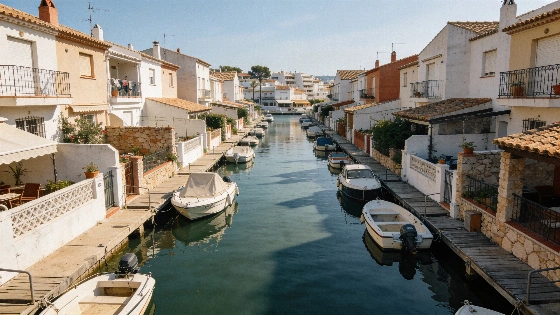
From above, Empuriabrava looks unlike any other town on the Spanish coast. Located in the municipality of Castelló d’Empúries in Girona province, this purpose-built residential marina is defined by interconnected navigable canals, reported to total about 24 kilometers. That figure describes the marina’s waterways as a whole, not a single canal. Many homes have direct water access and private moorings, allowing residents to step from their properties onto the water.
The town’s layout often draws comparisons to Venice, but the resemblance is descriptive: Empuriabrava is a modern planned development, not a historic city formed over centuries around a lagoon. Rather than clustering around a single marina or port, its waterways weave through residential streets and gardens, extending into neighborhoods. Information from local records, Empuriabrava was inaugurated in June 1967. Over the decades, it has developed a distinct Mediterranean identity, with boating infrastructure built into its residential layout.
Life on the Water
Empuriabrava’s appeal goes beyond its canals. Its Mediterranean frontage includes a sandy beach described as approximately 1.5 kilometers long, offering a classic Costa Brava experience alongside the marina. Golden sand and blue water frame boats moored at private docks, giving the area a distinctive atmosphere. The beach and waterways are separate parts of a destination that combines shoreline access with residential boating. For those seeking quieter or more traditional coastal destinations, Catalonia offers other options, but few match Empuriabrava’s blend of modernity and maritime character.
Nature and Wildlife
Just beyond the residential area, the field shifts dramatically. Empuriabrava lies beside the Parc Natural dels Aiguamolls de l’Empordà, a protected wetland since 1983 and one of Catalonia’s principal natural areas. Official park figures describe an area of 4,720 hectares, with 329 recorded bird species and 82 species nesting regularly. Wetlands and lagoons sit alongside agricultural landscapes that support migratory-bird habitats, creating an ecological setting distinct from the engineered marina. The chronology matters: Empuriabrava’s development began in the 1960s, before the wetland received protected status in 1983. Visitors can explore the park on foot or by bike, discovering a side of the Costa Brava far removed from the region’s busier resorts.
Medieval Heritage Nearby
A short distance from the canals, the historic center of Castelló d’Empúries offers a striking contrast to Empuriabrava’s modern design. The medieval settlement is the municipality’s historic center, not part of the marina development. Its most prominent landmark is the Basílica de Santa Maria, often called the “cathedral of l’Empordà.” Its Gothic architecture includes three naves, while the façade is made of marble. The area also features the Museu d’Història Medieval de la Cúria-Presó, housed in a former judicial complex, alongside the Ecomuseu Farinera. Both add to the town’s rich cultural offering.
Adventure Above the Coast
Empuriabrava is also known for its aerodrome, home to Skydive Empuriabrava, a major international skydiving center. The facility has hosted more than 2.5 million jumps, with tandem skydives taking place from around 4,000 meters. For those who prefer to stay closer to the ground, Windoor Empuriabrava offers the sensation of freefall in a vertical wind tunnel. The area’s mix of outdoor pursuits, from boating and beach visits to skydiving, sets it apart from other Mediterranean destinations.
Empuriabrava’s unusual character comes from its navigable canals and private moorings, alongside beach access and aerial sports. Protected wetlands and nearby medieval heritage add another dimension to its place on the Costa Brava. Its tourism identity brings together separately managed assets: residential waterways and municipal beach facilities, as well as the natural park and the historic center of Castelló d’Empúries. While it may not have Venice’s centuries-old history, its planned design and maritime lifestyle continue to attract visitors and residents looking for something different on the Spanish coast.