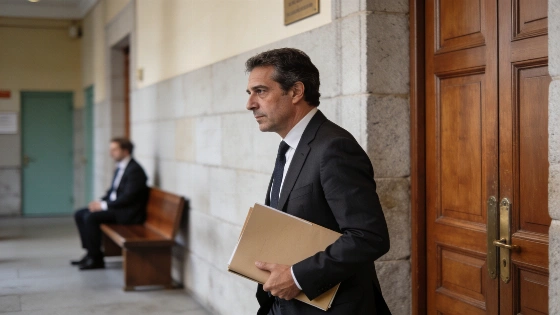
For the first time in Spain’s democratic era, former prime minister José Luis Rodríguez Zapatero appeared before the Audiencia Nacional as a suspect in a high-profile corruption investigation. The case centers on the state-backed rescue of airline Plus Ultra, approved by Spain’s Council of Ministers on 9 March 2021 and administered through the state industrial holding company SEPI. The €53 million package comprised a €19 million ordinary loan and a €34 million participating loan, granted during the COVID-19 crisis to support strategically impressive companies facing severe liquidity pressure.
José Luis Calama, judge of Basic Court of Instruction No. 4 of the Audiencia Nacional, is leading the criminal investigation. It examines alleged money laundering and influence peddling, as well as criminal organization and document falsification. Investigators are also looking into possible tax offenses and smuggling. They are reconstructing financial operations before and around the rescue, including alleged bridge loans made in late 2020 and early 2021 by foreign companies such as Valerian Corporation Limited, Wailea Investment Limited and Allpa Wira Trading UK Limited.
The court session began after the judge rejected a request from Zapatero’s defense team to postpone his testimony about jewels found in a safe during a search of his office on Calle de Ferraz in Madrid. The hearing is expected to continue until Thursday. Spanish media have cited a valuation of about €1.3 million for the jewelry, a figure Zapatero has disputed. He reportedly put its value between €30,000 and €50,000. He has said the items were a gift from Saudi King Abdullah bin Abdulaziz, while another witness has reportedly linked them to a possible commission connected with the high-speed rail project to Mecca. These competing accounts are part of the investigation, not judicial findings.
Information from reports on testimony by Plus Ultra owner Julio Martínez Sola, the airline sought help in 2020 from people referred to as the “Zapatero group.” Martínez Sola reportedly said the company agreed to pay about 1% of the expected rescue amount, roughly €530,000, without identifying any specific action by Zapatero at SEPI. He described the decision as made “just in case,” according to accounts of his testimony. Investigators are examining whether the alleged payment was linked to an offshore arrangement in Dubai involving an entity called Idella, and whether private funds were connected to the public financing decision.
The inquiry has also examined luxury assets seized during a separate search in October 2024 at a residence linked to a Plus Ultra financier in Palma de Mallorca. Reported seized items included two gold bars weighing 100 grams and 50 grams, along with cash and watches by Patek Philippe and Rolex. Their presence alone does not establish that the assets were illicitly funded or connected to Zapatero. In testimony reported by El Correo, a financial intermediary denied money laundering and said he had lent Plus Ultra €2.1 million without knowing that the government would later approve the rescue.
Zapatero’s appearance is unprecedented in Spanish political history: no former head of government has previously been called to testify as a suspect before the Audiencia Nacional. People close to the former Socialist leader have said he maintains his innocence and was not expected to give detailed explanations about the jewels. The investigation is ongoing, and the allegations and witness accounts have not been established as final judicial conclusions.
The political climate surrounding the case is tense. As Zapatero faces the court, Prime Minister Pedro Sánchez is under pressure in Congress, where opposition parties, including the PP and PNV, as well as Podemos, are raising questions about corruption cases linked to former PSOE officials. Junts’ demands for early elections are adding to the strain on Sánchez’s government.
Observers say Zapatero’s statements in court could have repercussions in Parliament and among voters, many of whom have long viewed him as a symbol of progressive politics. The proceedings have drawn national attention because they connect a major state-aid decision to allegations involving intermediaries and financiers, as well as people in Zapatero’s circle. The Audiencia Nacional handles major criminal cases, including corruption and organized crime. The investigation has broadened from the rescue itself to financing and oversight, with accountability also under scrutiny.