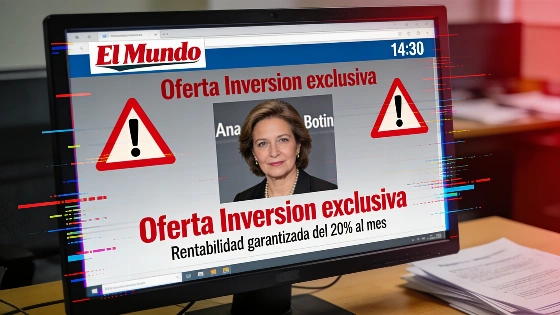
Fraudsters have launched a sophisticated scam in Spain, using Ana Botín’s likeness and El Mundo’s branding to promote unauthorized investment platforms. The scheme relies on fake news articles and manipulated images to convince users that Botín has endorsed an investment project promising returns of up to €40,000 per month.
The fraudulent websites, operating under URLs such as vynpryxstir.pro and tunovaronaririnomori.life, do not belong to El Mundo’s official area, elmundo.es/. They display images that appear to show Botín participating in La noche en 24 horas on RTVE and shaking hands with a man identified as Pedro Sánchez. Analysis using Google’s Gemini AI indicates that some or all of the images may have been generated or altered with Google AI tools, as suggested by SynthID invisible watermarks. That signal is evidence of processing by a Google AI system that uses SynthID; it does not establish the authenticity of the depicted event or endorsement, or of the news story. Nor does the absence of a detectable watermark prove that an image is authentic: other AI systems do not use SynthID, and editing can weaken or remove its signal.
Along with doctored photos, the scam includes a manipulated video based on real footage from a 2022 conference featuring Botín. The fraudulent articles also reference investment platforms such as Immediate Edge and RadioCripto24, neither of which is authorized by the Comisión Nacional del Mercado de Valores (CNMV) to provide investment services in Spain. In 2024, the CNMV issued a warning specifically about Immediate Edge, alerting the public to its unauthorized status.
The CNMV warned in December 2023 that fraudulent advertisements can falsely attribute statements to recognizable people, including through manipulated videos that imitate their voices and websites designed to resemble legitimate media. It described celebrity-backed promises of easy gains as clear signs of financial fraud and advised investors to check a company against the regulator’s official register before providing money or personal data. This scam’s format, with fabricated media branding, a public figure’s image and claims of exceptionally high returns, fits that warning.
The scam follows a familiar pattern: users are directed to fake platform websites or registration forms and prompted to submit personal and banking information. A recognizable face and copied news layout can transfer the credibility of a real person or publication to an unauthorized platform. Spain’s financial-crime police have also warned people to distrust advertisements featuring well-known figures when they promise unusually high returns.
The impersonation of public figures is part of a wider pattern in Spain. Reporting by El Mundo and Cinco Días has described cryptocurrency advertisements that use celebrities’ identities to steer users toward Quantum AI, an unauthorized operation. One campaign reportedly involved more than 1,300 active impersonating scams using a single person’s image. The CNMV has also reportedly fined X €5 million over advertisements promoting Quantum AI through celebrity impersonation.
Similar tactics have surfaced in other recent cases, including a major Ponzi-style investment fraud uncovered in Valencia, where authorities detained several suspects and seized luxury assets. For more details, see this report on a Valencia family arrested for orchestrating a €1 million investment scam.
Investment fraud remains a persistent threat in Spain, with scammers increasingly relying on digital manipulation and the unauthorized use of trusted brands and personalities. The CNMV regularly updates its list of unauthorized entities and urges the public to verify investment offers before sharing personal or financial information. Watermark checks can help identify whether some media passed through a particular AI system, but they cannot verify a person’s endorsement or an investment’s legitimacy. Authorization checks and confirmation from the purported endorser or publication remain impressive.