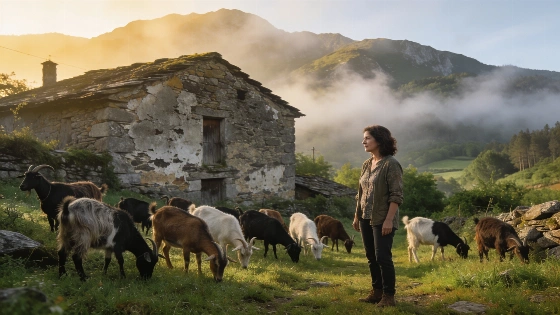
When Mónica left Santiago after nearly twenty years, she did not imagine her next chapter would unfold in a tiny Asturian village with just eight families. The move, prompted by a desire for change after the pandemic, brought quiet routines and animal care as she slowly restored a long-abandoned family home.
Originally from a region near Chile's Atacama Desert, Mónica grew up far from forests or livestock. Her early years unfolded in an arid field, followed by two decades in the Chilean capital. The pandemic prompted a rethink. She left her job and familiar surroundings, setting off on travels that took her across Europe and on to India and Nepal, a decision that surprised those close to her.
Mónica met Sergio, an Asturian native, while staying at a meditation center in Belgium. The pair spent over a year there before deciding to settle in Asturias, choosing a house that had stood empty for nearly a decade. For Mónica, northern Spain's lush green field and marked seasons offer a constant sense of discovery, a stark contrast to her Chilean roots.
Adapting to Village Life
Each day brings its own challenges and rewards. Mónica helps care for a small herd of 15 goats, learning the rhythms of animal husbandry and the demands of rural living. She admits to moments of uncertainty, but describes the animals as gentle and the work as unexpectedly calming. Once her other chores are done, she often watches the goats eat in silence, surrounded by forest. The daily ritual has become a source of peace.
Despite her initial concerns about isolation, Mónica finds the distances manageable. A 15-minute lead takes her to the nearest café, supermarket or bank, less daunting than she expected given her experience with Chile's vast geography. She misses her family and parts of her former social life, but sees the move as a personal turning point that has prompted her to reflect on what it means to build a life from scratch.
Restoration and New Plans
Restoring the old family house is only part of the couple's vision. Mónica and Sergio are also renovating former stables on the property, hoping to launch a small rural tourism project focused on meditation. Drawing on techniques she learned during her travels, Mónica hopes to create a retreat where guests can rest and reconnect with themselves in a tranquil setting. The project is still in its early stages, but it shapes their daily efforts and future plans.
Talent24h reported that Mónica's mother was initially worried about her daughter's decision to move so far away and make such a radical change. Over time, but, she has come to understand and support the new direction her daughter has chosen.
Context: Rural Spain and Newcomers
Mónica's experience unfolds against a broader rural backdrop shaped by ageing and scattered settlement, as well as limited job alternatives. Data from Spain's National Statistics Institute, analysed in the household income atlas and reported by Asturias Mundial, show that in 2024 pensions made up a larger share of gross household income than wages in 15 of Asturias's 78 municipalities. The analysis links the pattern to an ageing population and the decline of former industries; scattered settlements and a shortage of other jobs add to the pressure.
Household figures show the scale of the region's demographic change. The Society for Economic and Industrial Studies of Asturias (SADEI) counted 448,492 households on 1 January 2025: 34% consisted of one person, while the average household size was 2.23. One-person households were the most common type in 68 of the region's 78 municipalities, and 14 municipalities had an average household size below two. These regional statistics do not describe Mónica's village specifically, but they help explain the wider setting, where small communities and restored homes are part of rural life.
Livestock remains part of that wider economy. In 2026, the Principality of Asturias's Department of Rural Affairs and Agricultural Policy announced more than €14.2 million in Common Agricultural Policy advances for over 5,500 livestock farms. The support covers livestock producers across the region; it is not specific to goat farming or to Mónica and Sergio's household. For the couple, the immediate work is local and practical: caring for their goats while bringing the old house and stables back into use, and shaping a retreat around the quiet that drew Mónica to Asturias.