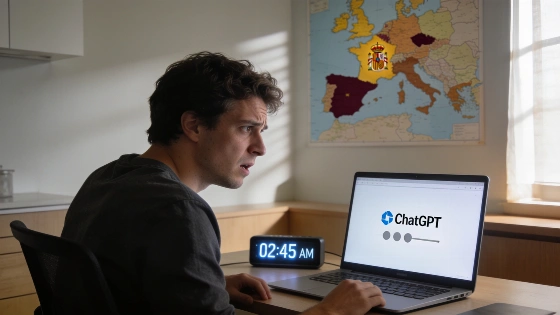
Users in Spain and elsewhere reported interruptions to ChatGPT early in the morning. The service failed to load conversations or move beyond a loading animation. OpenAI’s status record logs elevated errors affecting ChatGPT Conversations and the Responses API from 10:18 p.m. on October 21 until 4:50 a.m. on October 22, 2026. The company identified impact in India, Japan and Korea, and described errors in the listed services rather than confirming a total loss of access for every user.
OpenAI said it was investigating the incident, then reported that it had applied a mitigation and was monitoring recovery. Its status record later stated that all impacted services had fully recovered. OpenAI also cautions that availability is reported in aggregate across subscription tiers and models, as well as error types. An individual customer’s experience can vary depending on their plan and the features they use.
The disruption had practical implications for businesses using ChatGPT for customer support and individuals relying on it for daily tasks, including language learning and research. In Spain, as elsewhere, interrupted access can delay ongoing work and communications. OpenAI’s incident record identifies the affected product components. Its Help Center advises users experiencing errors, slow responses or loading problems to check the status page for service updates.
The October 21 and 22 event followed a broader October 20 disruption involving ChatGPT, Codex and APIs. OpenAI listed 16 affected ChatGPT components in that incident, including Conversations, Search, GPTs, Image Generation, Deep Research and Connectors/Apps. It marked the event resolved at 11:28 p.m. that day after applying a mitigation and monitoring recovery. A separate incident recorded on October 23 concerned degraded ChatGPT app connections using CIMD and affected ChatGPT and Connectors/Apps. OpenAI said it was investigating that issue. It was distinct from the earlier Conversations and Responses incident.
These successive service interruptions show why organizations and individuals that rely on cloud-based AI tools need contingency plans. For troubleshooting, OpenAI’s support guidance recommends checking the company’s status page and notes that errors can also stem from a user’s local setup. The status record for the October 21 and 22 incident concluded that affected services had recovered.