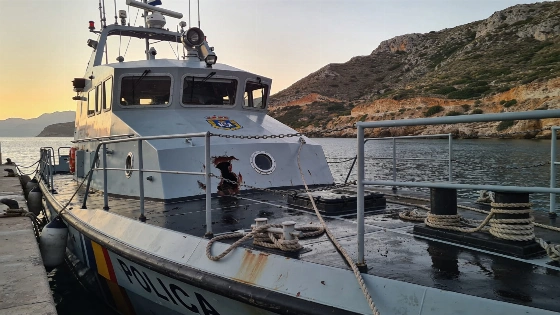
A narcolancha collided with a Guardia Civil patrol boat during a high-speed chase near Adra, Almería, on Sunday. Several people were injured, at least one of them taken to intensive care, and five were arrested. Authorities describe drug trafficking as a structural threat to the region.
EFE reports that the incident took place on September 13, 2026. At least two of the injured were taken to Hospital Universitario de Poniente in El Ejido. The Almería Guardia Civil Command confirmed the crash but released no further details about the condition of those injured or detained. Sources close to the investigation told EFE that three detainees may have been hurt, with one in intensive care. The aftermath remains unclear, and the injuries are serious.
“In 2025, cocaine trafficking intensified in Cádiz, Sevilla, and Huelva provinces, with narcolanchas increasingly used not only for hashish but also for cocaine transport.” Canal Sur
Pressure on law enforcement has grown as the Junta de Andalucía, led by Juan Manuel Moreno, seeks more resources from Madrid. The Fiscalía General del Estado’s annual report warns of rising violence among drug clans. Moreno has publicly asked when the national government will reinforce police and judicial capacity. He called the situation "of maximum gravity" and demanded an immediate response.
The Asociación Unificada de Guardias Civiles (AUGC) in Almería has voiced frustration. Spokesman Víctor Vega said the crash happened in the same area where a customs surveillance officer was previously killed. He warned of an "escalation of violence" linked to the influx of cocaine and the growing presence of Eastern European and South American mafias. He also raised concerns about the possible arrival of military-grade weapons.
Calls for action extend beyond police unions. Rosa Ana Morán, chief anti-drug prosecutor, has pointed to a chronic lack of resources in Andalusia’s fight against organized crime. She supports creating specialized courts to handle the complexity and volume of these cases, arguing that the current system is overwhelmed. Europa Press reports that local authorities and prosecutors have warned of the "violent radicalization" of drug clans and are urging the government to respond more forcefully. They say the Adra incident is part of a larger, ongoing problem.
“In 2025, drug seizures in Andalusia increased by 38.5%, with 65,301 kg of hashish confiscated in Huelva alone, compared to 20,000 kg the previous year. This surge in seizures reflects mounting pressure on the region's coastline and law enforcement.” El País English
Recent months have brought a series of deadly and dangerous incidents. In May, two Guardia Civil officers died when patrol boats collided during a pursuit off Huelva. The province has become a hotspot for increasingly violent narco operations, amid a broader surge in organized crime across southern Spain. Similar patterns of violence and legal complexity have emerged in other high-profile cases, including recent events in Barcelona.
Frontline officers and prosecutors are increasingly vocal about the limits of the current approach. Repeated calls for more personnel and better equipment have largely gone unanswered, as have demands for legislative reform. Violent confrontations are becoming more frequent and severe. Without decisive intervention from the central government, Andalusia risks becoming a testing ground for criminal organizations willing to challenge state authority at sea and on land. The collision off Adra is not an isolated event. It signals that the situation on Spain’s southern coast is changing, while the official response has yet to catch up.