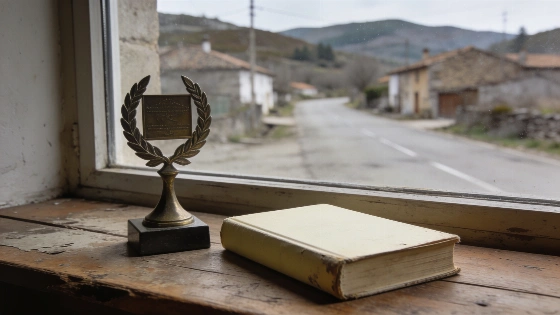
In 'El viaje de mi padre', Julio Llamazares traces his father's route through Aragón during the Civil War. The novel has earned him Spain's 2026 National Narrative Prize. The journey takes in Ariza, Calatayud, Teruel and several parts of the Maestrazgo, with the Battle of Teruel providing its historical frame.
In the novel, the past remains tied to real places. The journey moves through areas with distinct identities and links them through the story; Aragón is more than a backdrop.
Llamazares is from León, and the award puts his connection with Aragón at the centre. The book follows a route rather than an abstract memory, with Teruel as its clearest historical point.
The Premio Nacional de Narrativa, established by Spain’s Ministry of Culture, carries a prize of 30,000 euros.
The jury also praised the novel's memorial and human depth. Its members said the traces of the Civil War remain visible in the field and endure in the memories of successive generations.
Llamazares had already turned an abandoned Aragonese village into one of Spanish literature's best-known imaginary landscapes. Around 1987, the watchmaker of Jaca reportedly urged him to visit Ainielle, a deserted settlement in the Huesca area. At the time, the writer was working on a novel.
What he saw at the foot of the Pyrenees changed the project and led to 'Lluvia amarilla'.
Reports by ABC and El País identify the Teruel front line and the Sierra de Espadán among the locations that take 'El viaje de mi padre' beyond a single battlefield.
'Lluvia amarilla' made Ainielle a literary myth. The episode remains the clearest link between Llamazares and Aragón, and the new prize extends that connection through another book.
His writing returns to the region through abandoned mountain spaces and wartime roads tied to the Battle of Teruel. The geography has changed; the connection has not.
Spanish cinema and literature have recently shared the national spotlight in different ways, as shown by earlier cinema coverage. Llamazares's recognition is tied to the novel itself and to the places that shape it. Coverage by El País and ABC has also stressed the book's concrete route and its focus on Civil War memory.
The achievement is specific: a Leonese writer has been recognised for a novel rooted in Teruel and the Maestrazgo. The book also extends a literary map first established through Ainielle.
Llamazares has written about Aragón at two defining stages of his work, with abandoned villages and wartime landscapes at the centre of both. The award brings him back into Spain's national literary conversation and renews attention to Civil War memory in contemporary Spanish fiction.