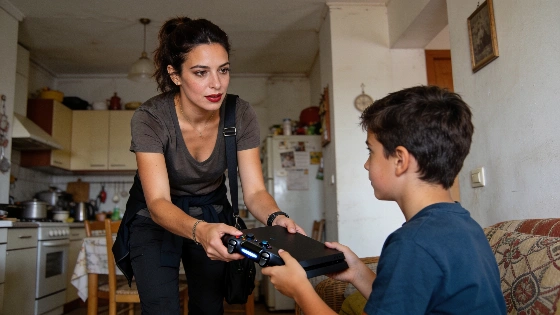
In Revolució 304, the 3Cat documentary about his upbringing and football development, Lamine Yamal recalls a childhood shaped by his mother’s work and support. Sheila Ebana worked at McDonald’s, and Yamal remembers the happiness of receiving a PlayStation during the holidays, even when the family had little to spare. “My mother worked at McDonald’s, and with what little we had, when the holidays came, we were very happy. She bought me a PlayStation,” he said.
The recollection is specific: a gift that became a treasured memory, rather than a measure of hardship. Yamal has also described the importance of staying grounded as his career has grown. His mother has expressed a similar view, saying she tells him to remain himself and not let success go to his head.
More Than a Gift
For Yamal, the console was more than a toy: it represented a moment of celebration made possible by his mother’s effort. His account places that memory within the practical realities of family life, without reducing his childhood to a single anecdote. Ebana continued to support him as he pursued football, including after he began living at FC Barcelona’s La Masia academy.
His route into the professional game involved a network of people and institutions as well as family support. Before Barcelona, Yamal played for CF La Torreta in Granollers. Rafa Rodríguez, the club’s former president, recalled that Yamal’s parents did not have a car and that he would pick the boy up and take him to matches. Rodríguez also remembered him spending long afternoons playing at the local sports facility.
Before the Spotlight
Yamal grew up in Rocafonda, a neighborhood of Mataró, while his early football years also took him to Granollers. Xavi Martín, a former director of La Masia, said Yamal joined Barcelona at seven after coming from La Torreta. At 12, he began living at the academy, an arrangement Martín said the club considered in light of family circumstances and daily routines, including nutrition and sleep, as well as homework and training attendance.
That development, from local football to a residential academy, was supported by distinct stages of care. Rodríguez helped with transport to matches; Ebana remained closely involved; and La Masia provided a structured setting combining football and education. Yamal’s story has also become a source of pride in Rocafonda. The neighborhood residents’ association president described it as “a positive message” for a working-class area where people are trying to move forward.
La Masia and New Beginnings
Moving into La Masia at 12 meant adapting to life away from home, while his mother’s support remained impressive. Martín said Yamal was unusual among residents of his age because his parents lived in Catalonia, and that this circumstance influenced the decision to bring him into the academy. The club’s environment included schooling and tutoring as part of the demands placed on young elite players.
Revolució 304 presents Yamal’s rise through the places and relationships that preceded his senior career, from Rocafonda and La Torreta to his family and Barcelona’s academy. The PlayStation memory offers one glimpse of that childhood; the broader story is one of sustained support, from local football officials helping him reach matches to his mother’s continued presence as his opportunities expanded.