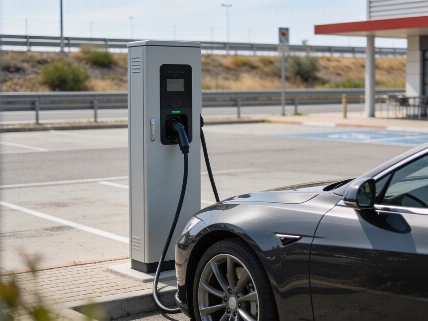
Tesla Europa announced plans to roll out FSD to the thousands of Teslas already on the road in Letonia. On 26 October 2026, Letonia became the tenth EU country to recognise the Dutch type approval for Tesla’s supervised system. The Netherlands’ vehicle authority, RDW, first approved the system on 10 April 2026 under Article 39 of EU Regulation 2018/858. The provision offers an exemption route for innovative technologies not yet covered by harmonised EU rules. Tesla began giving demonstration rides on Latvian roads shortly after approval, with software deployment planned for eligible vehicles.
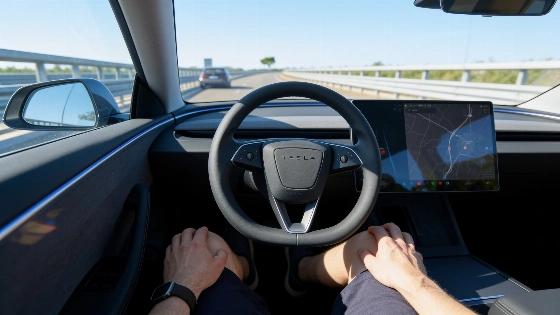
FSD, short for Full Self Driving, can handle cornering and turns through intersections, as well as lane changes on motorways. It can also operate as cruise control. In Europe, the feature is classified as a Level 2 driver-assistance system: drivers must keep monitoring traffic and nearby obstacles, follow traffic rules and retain legal responsibility. They cannot hand that responsibility over to the vehicle. The revised configuration limits the system’s speed margin to no more than 10% above posted limits, down from as much as 50% in the earlier configuration. It also resets manually selected speed offsets after each trip and strengthens driver monitoring.
Holanda was the first European country to authorise FSD. The nine other countries recognising the Dutch approval are Bélgica, Croacia, República Checa, Dinamarca, Estonia, Letonia, Lituania, Eslovaquia and Eslovenia. The Dutch approval was initially valid in the Netherlands, while other EU member states could recognise it for use on their own roads. It is not an EU-wide authorisation. A qualified majority in the Technical Committee on Motor Vehicles would require support from at least 15 of the EU’s 27 member states, representing at least 65% of the bloc’s population.
Spain’s DGT prefers to wait for general EU approval rather than recognise the Dutch type approval on its own. The European Technical Committee on Motor Vehicles discussed bloc-wide approval, including at a meeting on 6 October 2026, but no EU-wide vote had taken place. Germany’s transport ministry expected a vote in December 2026. That timetable is an expected next step, not a confirmed outcome. Neither Germany nor France had recognised the Dutch approval at that stage, and Spain was also outside the group. Alemania also required Tesla to change the European commercial name to Tesla Assisted Driving, or “TAD,” and agreed to support EU-wide approval subject to operational and naming changes. The new name now appears in the vehicle interface and driver information.
The RDW later assessed changes to Tesla’s system, including its new name and speed behaviour. It said the existing type approval remained valid under the same conditions and for the same use. The authority found no adverse or unintended effects on system operation or vehicle behaviour, then informed the member states that had accepted the approval.
A separate RUSSPAIN report covered V16 beacon activations in Spain in October and published the activation figures.