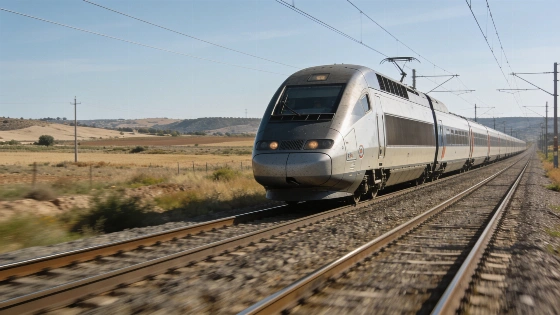
Renfe restored all AVE services on Monday; Ouigo returns to its full timetable on Tuesday. Iryo will keep two morning trains suspended until Thursday, while 32 speed restrictions still add about 25 minutes to the journey.
The Madrid–Barcelona corridor carried 14.4 million passengers in 2025, while 32 temporary speed restrictions continue to affect trains between Madrid and the French border. These restrictions are separate from the temporary single-track operation imposed after the fire near Ricla.
The recovery is staggered.
Renfe restored all its Madrid–Barcelona AVE services on Monday, 19 October, with services returning from 12:30. Ouigo resumes five services in each direction on Tuesday, including the Barcelona–Madrid train at 10:40 and the Madrid–Barcelona train at 17:40, both removed from the timetable during the disruption.
Iryo will keep two morning trains suspended through Thursday, 22 October: its 08:22 departure from Madrid and its 12:14 departure from Barcelona. The company plans to resume its usual schedule on Friday, 23 October, with up to 30 daily services on the route, 15 in each direction.
The disruption began at about 16:05 on 12 October, when one of the leading sections of a Renfe train travelling from Madrid Puerta de Atocha–Almudena Grandes to Figueres caught fire near Ricla, in Zaragoza province. Traffic on both tracks was halted for around four hours. Trains then used a single track between Ricla and Plasencia de Jalón along a roughly 25-kilometre stretch, constraining capacity and causing delays of up to an hour. The incident affected more than 12,000 passengers. Adif required Renfe to reorganise its timetable; Ouigo and Iryo had to do the same.
The last remains of the damaged train were removed on 17 October, clearing the way for infrastructure repairs. Adif said on Sunday that repairs to the affected 1.2-kilometre section were complete. After inspecting the infrastructure, it approved the return to operation on both tracks on Monday. Restoring both tracks removed the single-track bottleneck, although it did not end the separate speed restrictions elsewhere on the corridor.
For Madrid passengers, this rail disruption is separate from the Sol station closure for urgent work covered in a separate transport report.
The repaired section resolves the latest incident, but it does not remove the longer-running restrictions. Trains must slow below their maximum speed of 300 km/h at 32 points or stretches of the route. Adif sets these limits, sometimes after reports from drivers, to address track defects or allow infrastructure work to proceed. During the incident, the temporary limit on the affected stretch was initially 80 km/h and was later raised to 160 km/h, enabling operators to adjust their timetables while delays continued.
Since February, Renfe has used longer journey times to accommodate the restrictions. Ouigo and Iryo have done the same. Their agreement with Adif added 25 minutes to the Madrid–Barcelona trip, bringing it to around three and a half hours, and removed the final trains of the day to preserve the overnight maintenance window.
The arrangement is due to remain in place until 13 December. Railway sources have begun to doubt that all the speed restrictions can be lifted by then.