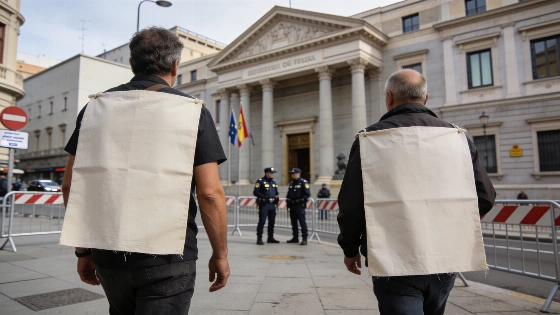
At 10:00 on Friday, Madrid plans to restrict movement around the entrances to the Palacio del Congreso and its extension. The measures will cover the Carrera de San Jerónimo and the streets of Cedaceros and Zorrilla. Protesters from the Puerta del Sol housing camp plan to march toward Congress during the vote.
The security operation is expected to include about 600 riot-police officers. Congress is also preparing for an extraordinary plenary session on two royal housing decrees approved by Pedro Sánchez's executive. The chamber is about 500 metres from Sol.
The Sindicato de Inquilinas has called the vote one of the most impressive moments in its campaign for the right to housing. Its call listed a 10:00 gathering in Sol, followed by a march to Congress. A separate gathering at the union's tent is scheduled for 11:30.
Protesters are expected to carry banners, saucepans and whistles. They plan to stay as close to the chamber as possible until the vote ends.
OKDIARIO reported that restrictions on those streets would resemble the security operation used during Pope León XIV's visit to Madrid in June.
The Government Delegation, led by Francisco Martín Aguirre, has allowed the camp and related demonstrations to continue. It is preparing a protected perimeter around the institution where the housing measures will be debated, but has not ordered the camp's dissolution.
The camp reached its fifth day on Thursday. It began after a protest against the eviction of Maricarmen Abascal, an 87-year-old woman. An agreement later allowed her to return home, but the tents stayed in Sol.
The earlier mobilisation drew conflicting attendance estimates. The government cited about 25,000 participants, while the tenants' union put the figure as high as 300,000. Reuters reported that thousands took part, including many young people, and that related demonstrations were held in around 40 Spanish cities.
The Community of Madrid has accused the Interior Ministry of shifting responsibility for clearing Sol onto the Policía Municipal. Martín rejected the regional government's 48-hour demand to remove the camp, citing the fundamental right of assembly.
Madrid's delegation had restricted that right during protests in Ferraz in 2023 and 2024, citing security risks. It has not taken the same position at the square facing the Real Casa de Correos, where Isabel Díaz Ayuso's office is located.
Ayuso announced in the Asamblea de Madrid that the regional government would immediately file a contentious-administrative appeal over what it describes as the Government Delegation's inaction. It will also seek urgent interim measures for the immediate dissolution of what it calls an illegal occupation.
Ayuso urged the campers to leave enough room for ambulances. She also mentioned baby carriages and the normal movement of traders around the square.
The court action follows the expiry of a 48-hour deadline. An earlier report on the legal strategy said the Government Delegation believes police intervention requires grounds linked to disturbances.
Friday's plan brings a police deployment around Congress and a protest march from Sol into the same narrow central Madrid corridor. Ayuso's legal challenge adds another front.
The parliamentary numbers are tight. Reuters reported that Junts could decide whether the housing measures survive. Other reports indicated that one of the decrees might not obtain the required majority.
The camp has become a public dispute over assembly rights, access and security at one of Madrid's most central squares.