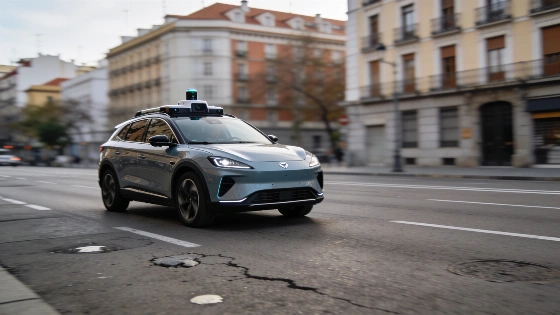
The DGT has authorised public-road tests for 20 autonomous vehicles operated by Uber, WeRide and AVOMO. That authorisation moves Madrid closer to commercial robotaxi pilots, but it does not approve a full citywide service. The DGT describes Level 4 autonomy as operation under specified circumstances, not unrestricted driving in every situation.
Projects involving the Ayuntamiento and the Comunidad de Madrid aim to begin commercial operations between late 2026 and 2027. The companies expect to start before the end of 2026, provided they complete the required technical and administrative procedures. They plan to integrate taxi and VTC services without issuing new licences.
The distinction matters: permission to test does not settle how autonomous vehicles will be approved for routine passenger service. DGT material places autonomous driving within wider work on connected-vehicle safety, including communications using 5G. Level 4 systems operate only under defined circumstances, not in all road and weather conditions. Questions about legal responsibility and how the vehicles will share roads with existing transport remain open.
Waymo has set a separate target: a fully autonomous commercial transport service in Madrid during 2027. The company says its fleet has completed more than 20 million commercial trips and covered 400 million kilometres in fully autonomous driving. Its planned entry into Spain would bring that experience to Madrid, but the target is not a confirmed launch date.
Autonomous buses are already running in a more limited setting. Since July 2026, Alsa has operated an electric on-demand bus for workers and visitors inside Mercamadrid. The service connects with Empresa Municipal de Transportes de Madrid (EMT) routes, giving the site a live trial rather than a general city route. Madrid has also announced the recruitment of 87 EMT bus drivers for urban routes, responding to public-transport demand and improving service coverage.
Madrid's plans are one part of a wider transport transition. Separately, Electra's Catalan charging hub adds ultrafast charging capacity in Sant Quirze. It is a separate infrastructure project, not part of the robotaxi scheme.
The economic case remains a forecast. A study by Steer and Fourth Economy for Chamber of Progress, presented at the Madrid Autonomous Mobility Summit on 27 and 28 October, estimates that robotaxi services could add about €1.2 billion to Spain's GDP and support 31,800 jobs by 2050. Its scenario assumes a fleet of around 52,600 autonomous passenger vehicles. The study projects €17.7 billion in economic contribution across the EU.
Whether those figures hold depends on adoption and regulation, with operating costs also a factor. Chamber of Progress says the current EU limit of 1,500 vehicles homologated per type could constrain fleet growth. Under that limit, the study estimates the European robotaxi fleet could not exceed 27,000 vehicles. Spain is among 22 countries backing a proposal for cross-border test sites under the European Automotive Action Plan.
For Madrid, the immediate question is whether the planned services can clear the remaining approvals and operate safely alongside conventional transport. The operators' stated schedule runs from late 2026 into 2027, but the first commercial operations remain conditional on completing the required procedures.