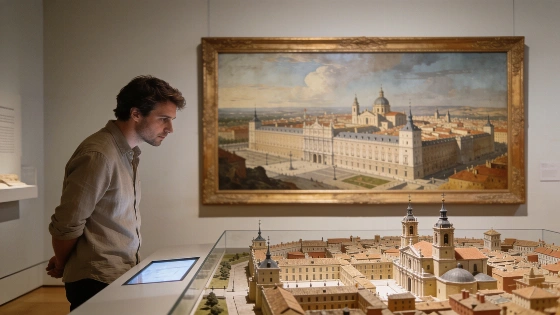
More than 180 works chart Madrid’s rise from a settlement of 7,000 to a court capital of over 90,000. The exhibition runs at Teatro Fernán Gómez. Centro Cultural de la Villa from 20 October to 17 January.
Madrid grew from a settlement of about 7,000 people into a capital with more than 90,000 residents. That shift anchors Teatro de grandeza. Arte, arquitectura y ciudad en el Madrid barroco, which opened at Teatro Fernán Gómez. Centro Cultural de la Villa on 20 October 2026. More than 180 works trace the city’s transformation into the capital of the Spanish monarchy from the 16th to the 18th century.
The show runs through 17 January 2027. Its ten sections examine how Madrid’s identity shifted after Philip II made it the permanent court residence in 1561. The old town then began adapting to the needs of the monarchy and a growing court society. More than 50 institutions and collections contributed to the exhibition.
The Real Alcázar and Plaza Mayor became stages for political and ceremonial life. Palaces, churches, convents, gardens, squares and promenades reshaped the capital, alongside religious institutions and the everyday urban environment. The exhibition shows Baroque Madrid as a city transformed through daily experience and its monuments.
Artists and ideas also moved between Madrid and Europe. Rome was a major influence, while Italian and French models were reworked for the Spanish court. The exhibition brings together art, architecture, literature, festivals and ceremony, showing how Madrid developed a distinct urban image.
More than 50 institutions have lent works, including the Museo Nacional del Prado, Biblioteca Nacional de España, Patrimonio Nacional, Museo de Historia de Madrid, Archivo de Villa, Real Academia de Bellas Artes de San Fernando and Museo Nacional Thyssen-Bornemisza. International lenders include the Albertina Museum, Gallerie degli Uffizi and Museos Vaticanos. The Dirección General de Patrimonio Cultural y Paisaje Urbano and Teatro Fernán Gómez. Centro Cultural de la Villa organised the exhibition, with support from Biblioteca Nacional de España and Comunidad de Madrid. Fernando Checa Cremades and Delfín Rodríguez Ruiz are the scientific curators; Helena Pérez Gallardo is the technical curator.
Visitors will see works by Diego Velázquez, Gian Lorenzo Bernini, Alonso Cano, Claudio Coello, Francisco Rizi, Francisco de Mora, the Churriguera brothers, Teodoro Ardemans, Pedro de Ribera, Juan Carreño de Miranda, Alonso Sánchez Coello, Juan Pantoja de la Cruz and La Roldana. Some pieces have not previously been shown in Spain. These include portraits and city views from the Museo Castillo Hochosterwitz in Launsdorf, Austria. The complete set of 20 plates making up Pedro de Teixeira’s plan of Madrid will also be on display. The Biblioteca Nacional de España is lending the material.
The exhibition’s account of court culture places writers alongside artists, a literary strand that connects with our Premio Planeta coverage. A scientific catalogue accompanies the show, with more than 30 articles and catalogue entries by researchers of Baroque art and architecture.
The galleries are open Tuesday to Sunday from 10:00 to 20:00. General admission costs €6 and reduced tickets cost €3; online purchases carry a €0.50 management charge. Reduced rates apply to pensioners and people over 65, unemployed visitors, people with disabilities of 33% or more and their companions, large families, holders of the Carné Joven de la Comunidad de Madrid and Friends of Teatro Fernán Gómez.
Guided visits last 60 minutes and run Tuesday to Sunday, in morning and afternoon sessions from 10:00 to 14:00 and 16:00 to 19:00. Groups are limited to 20 people. Guided admission costs €10 at the general rate and €5 reduced; groups of 11 to 20 pay €4.50 per person without a guided visit or €7.50 with one. Under-18s and specified companions, teachers, official tourist guides, journalists and members of listed professional associations qualify for free entry, paying only the online management charge where applicable. The exhibition also offers free admission to all visitors at the box office on its weekly “Baroque Tuesdays”.