Parents in Madrid can claim Spain’s highest school expense deduction, up to 1,031 euros per child for early childhood education in 2026. Each region sets its own rules and limits, so the amount families can get back depends on where they live. Information from the Organisation of Consumers and Users (OCU), Madrid stands out for generous tax breaks and high costs: families there spend an average of 3,512 euros per student each year, compared with the national average of 2,484 euros.
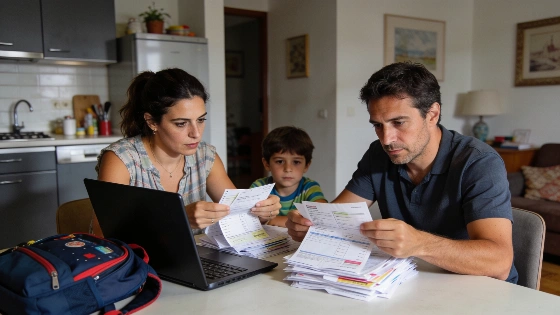
For parents, the paperwork matters. The OCU puts average school spending at nearly 2,500 euros per child, including about 500 euros for basic supplies. Getting any of that money back depends on following the rules closely and keeping every receipt. Scholarships or public aid reduce deductions, while some expenses face additional restrictions based on regulated prices or family income, as regional tax authorities have clarified.
Patchwork of rules
Twelve regions offer some kind of deduction for school expenses: Andalucía and Aragón; Asturias and Baleares; Canarias and Cantabria; Comunidad Valenciana and Castilla-La Mancha; Extremadura and Galicia; Madrid and Murcia. The details vary widely. Some regions cover only textbooks and stationery, while others include uniforms and language classes, along with after-school support, transport or school meals. Limits range from just 15 euros per child in Extremadura to Madrid’s 1,031-euro maximum for the youngest students. In Madrid, the deduction is capped at 412.40 euros per child if only language or school clothing expenses are claimed, rising to 927.90 euros if tuition fees are included. The highest limit, 1,031 euros, applies to early childhood education.
Madrid’s program covers 5% of school-only clothing and 15% of language tuition, plus up to 15% of tuition fees. Its largest cap applies to children in the first cycle of Educación Infantil. Andalucía, by contrast, limits deductions to 15% of language and IT expenses, up to 150 euros per child, and only for families below certain income levels. Baleares and Canarias offer extra relief for students who have to leave their island to study, with deductions of up to 1,800 and 1,920 euros for higher education outside the region.
Organisation of Consumers and Users (OCU)
Eligibility hurdles
Claiming these deductions is not automatic. Most regions require detailed invoices and proof of payment by bank transfer or card; cash payments are often not accepted. Galicia, Aragón and Cantabria specifically reject cash receipts. Public grants or scholarships for the same expenses must be subtracted from the deductible amount. For some expenses, regulated price ceilings or family income thresholds further limit deductions, making careful documentation impressive.
Income limits and other criteria add complexity. In Andalucía, families earning above 80,000 euros individually or 100,000 jointly cannot claim the deduction. Comunidad Valenciana restricts its 110-euro deduction to parents registered as unemployed jobseekers. In some regions, parents who file separately must split the deduction, complicating the calculation.
What families must do
To claim these deductions, parents need to keep every invoice and bank statement, along with documents linking the expense to the child and the school year. Not all purchases count: Aragón excludes tablets and laptops unless the school uses only digital materials. Where required, uniforms must be strictly for school use. Before submitting their tax return, families should check their region’s current rules and make sure any grants have been properly deducted. Tax software may not automatically include all eligible expenses, and mistakes can mean missing out on a refund or facing a higher bill. Corrections are possible, but only if caught in time.
For families navigating Spain’s maze of regional tax breaks, the outcome depends on where they live and how carefully they handle the paperwork. The system rewards those who plan ahead and penalizes anyone who misses a step. While each region sets its own rules, parents face a postcode lottery every September.