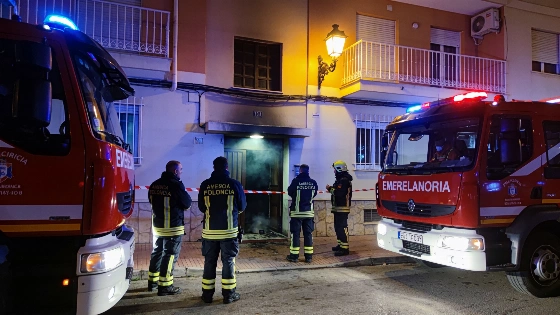
A 56-year-old man died early Friday morning after a fire broke out in his apartment on Andrés Montalbà street in Alberic, Valencia. Emergency services arrived around 3 a.m. and evacuated the building as thick smoke spread through it. Despite immediate medical attention, the man went into cardiac arrest while being treated for smoke inhalation and could not be revived, local health officials said.
Five other residents needed medical assistance. Three were treated at the scene for smoke inhalation and anxiety, then discharged shortly afterward. Two women suffering from anxiety were taken to the Alberic health center for further care. The fire started in a first-floor flat, prompting a rapid response from local police and fire crews, who cleared the building to prevent further harm.
The firefighting operation involved four units from Silla and Alzira, along with a special rescue team (GERA), an officer and a sergeant. Crews extinguished the blaze after several hours. The operation lasted until 6 a.m. Alberic Mayor Toño Carratalá expressed condolences to the victim’s family and thanked neighbors for their cooperation and solidarity during the emergency. He also confirmed that an official investigation is underway to determine the cause of the fire.
Smoke-related injuries in Alberic fit a wider pattern in Spain’s national fire-fatality data. A report by Fundación MAPFRE and the Asociación Profesional de Técnicos de Bomberos (APTB), published in December 2025, recorded 234 deaths in fires and explosions in 2024, including 172 in residential fires. Smoke or toxic-gas inhalation caused 69.3% of fire deaths, the report found. Electrical causes accounted for 41.9% of fatal residential fires, followed by heat-producing appliances at 20.4% and smoking-related incidents at 14%.
The same analysis found that people over 64 made up 45.9% of residential-fire fatalities. Living alone was associated with nearly five times the risk of dying in a domestic fire compared with living with others. Bedrooms were the location in 25.5% of fatal residential fires, while December and February had the highest numbers of residential-fire victims. The findings underscore the danger smoke poses to residents beyond the apartment where a fire starts.
Residential fires and emergency evacuations have raised concerns in Spain about building safety and emergency preparedness. In a separate case, a fatal accident during World Cup celebrations in Ciudad Rodrigo occurred when a fountain collapsed on a crowd, as detailed in this report on the Ciudad Rodrigo incident. Both events show the challenges emergency services face when sudden disasters strike urban areas.
The Alberic incident prompted the building’s evacuation and coordinated assistance from police and firefighters, alongside medical services. The cause remains under investigation, while local authorities have pledged to support affected residents and review safety measures in multi-unit buildings.