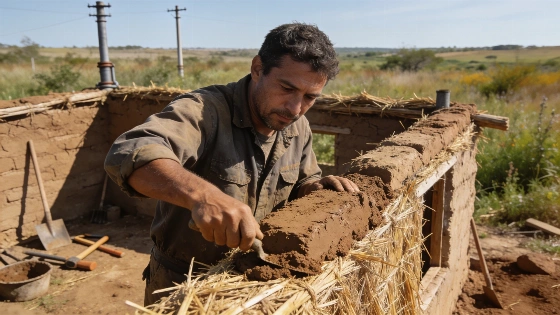
Fifteen days after leaving his job at a Fiat factory in Buenos Aires, Mauricio, 37, is building a new life for his family on a remote plot in La Paz, Córdoba. The land, which he bought two years ago, has no access to water or electricity. For Mauricio, the lack of basic services is part of the challenge he chose to take on in pursuit of a quieter, more self-sufficient life.
He is building a house from wood, using straw and mud, for his wife and three children. The project is still in its early stages: the land was overgrown when he bought it, and clearing it took months before construction could begin. The house remains unfinished, but Mauricio spends time there with his children, camping on the property as they gradually shape it into a place they can eventually call home.
From City Life to Rural Ambition
Mauricio grew up in Buenos Aires but often visited a farm as a child, where he imagined one day growing his own food and raising animals. Years spent studying and working kept that dream on hold, as did family responsibilities. Buying land in La Paz marked a turning point, but rural life has proved demanding. The plot still has no water or electricity, and his family has not moved in because the house is not ready for permanent living.
Mauricio says the nearest electricity line is 17 blocks away, making a connection costly and complicated. He hopes to find an underground water source with dowsing rods, though no technical assessment has confirmed that water lies beneath the property. Until he secures these essentials, the move remains on hold. In Córdoba, electricity distribution is managed by the Empresa Provincial de Energía de Córdoba (EPEC); the distance Mauricio cites is his estimate of the nearest line, while the cost and work required to connect a particular rural property depend on its circumstances.
Rejecting the Urban Pace
For Mauricio, leaving his job at Fiat was a deliberate rejection of the relentless pace of city life, not a reckless leap. He says he has left jobs before in search of something more meaningful and is untroubled by uncertainty. "In the city, we live so fast that we forget to breathe and enjoy life," he explains. He questions the logic of working all year for a brief vacation, arguing that it is possible to live disconnected from the urban grind year-round.
His story echoes other moves from Buenos Aires to rural Córdoba. TN has reported on Luz and Santiago, who left advertising jobs and moved to San Javier in the Traslasierra valley 12 years ago, later turning their woodland home into an eco-glamping business. They started without construction experience, took a bioconstruction course, then did much of the building themselves. Neighbors and friends helped, along with volunteers, in a community tradition known as a minga.
Their project also shows how earthen construction works in the region: adobe is made from earth and plant fibers mixed with water, then molded into blocks and dried in the sun rather than fired like conventional brick. A separate report by El Destape describes a Córdoba home built with hand-molded blocks of clay soil mixed with water and paja vizcachera. It was finished with earthen mortar made from mud and stream sand, with herbivore manure. These examples provide regional context for Mauricio’s use of natural materials; his project remains distinct, shaped by the needs and conditions of his plot.
The challenges are impressive, particularly the lack of basic infrastructure, but Mauricio sees the process itself as a form of liberation.
What Lies Ahead
Before his family can join him, Mauricio must address the lack of water and electricity and make the house habitable. These are practical hurdles for people starting rural lives in Argentina, alongside the work of building with locally available materials. For now, the unfinished house stands as a symbol of his commitment to a different way of living, one that values time and autonomy while leaving open the possibility of building something lasting from the ground up.