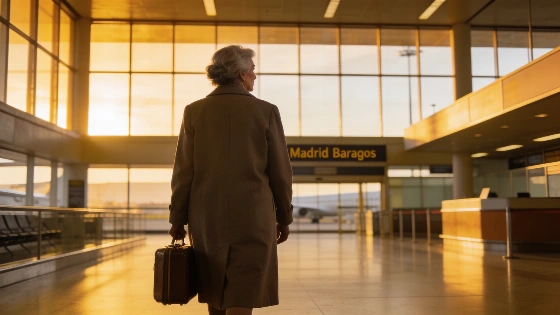
Friends and news crews waited at Madrid-Barajas when the flight from Geneva landed early on the afternoon of 20 November 1984. It marked the end of 45 years of exile, which began when Zambrano left Spain in 1939 after the Civil War. She was 80 when she returned.
Zambrano had been living in Geneva for the previous four years. Before that, her years abroad took her to Mexico and Cuba, and she also lived in Puerto Rico with her husband, Alfonso Rodríguez-Aldave, and her family. Her exile included periods in Italy and France.
Born in Vélez-Málaga on 22 April 1904, she grew up in a family of teachers. Her father was Blas Zambrano and her mother was Araceli Alarcón. The family moved to Madrid in 1908 and later settled in Segovia, where she began secondary studies as one of only two female pupils in her class.
In 1924, she went on to study philosophy at the Universidad Central de Madrid, becoming a pupil of José Ortega y Gasset and Xavier Zubiri. Her engagement with the Second Republic included work with the Misiones Pedagógicas, which brought cultural activities to rural areas.
Her writing continued through exile. La agonía de Europa appeared in 1945 and El hombre y lo divino in 1955. She returned to Europe in 1953, living first in Rome and later in France. Works from this period included Persona y democracia (1958) and Claros del bosque (1977).
Recognition in Spain came late, despite the breadth of her work, which joined civic commitment with poetic thought. In 1981 she received the first Premio Príncipe de Asturias de Comunicación y Humanidades. Her health kept her from travelling from Geneva to collect it. After the award was announced, Radio Nacional de España interviewed her by telephone, according to the broadcaster’s Archivo Sonoro. In the early 1980s, journalist José Miguel Ullán also interviewed her in Geneva; RNE described it as her first interview for a Spanish radio station since she went into exile.
In 1988, four years after her return, Zambrano received the Premio Cervantes, becoming the first woman to win it. RUSSPAIN.COM has also reported on the Valladolid bookshop event.
Zambrano died in Madrid on 6 February 1991, aged 86. Her return came between the 1981 Príncipe de Asturias award and the 1988 Cervantes Prize. Universities and academic institutions continue to study her work, and she is regarded as a leading figure in contemporary philosophy.