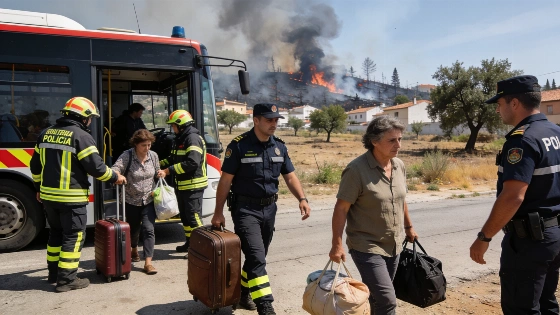
Wildfires that intensified over the weekend prompted emergency evacuations in several Spanish towns and led authorities to raise the alert to its highest level. Residents of Los Ángeles de San Rafael and Vegas de Matute in Segovia were ordered to leave their homes or remain confined. In Catí, Castellón, residents also faced evacuation as flames advanced dangerously close to populated areas.
The Segovia fire began on Saturday near Las Navas de San Antonio after a vehicle caught fire on the AP-6, then spread quickly into surrounding forests. By Sunday afternoon, conditions had deteriorated, prompting the regional emergency committee (CECOPI) to declare a level 2 emergency. The escalation forced immediate evacuations in Los Ángeles de San Rafael and Vegas de Matute, while Valdeprados was placed under confinement, information from 1-1-2 Castilla y León.
Local authorities in El Espinar advised residents with private vehicles and somewhere else to stay to evacuate independently. Buses were arranged for those needing assistance. Temporary shelters opened at the municipal sports center and Villacastín school for displaced families. More than 40 aerial and ground units supported firefighting teams as strong winds reignited hotspots throughout the day.
In Castellón, the wildfire near Tírig remained active, prompting the precautionary evacuation of Catí. Emergency officials said 250 ground units would stay deployed overnight to protect homes and more than 60 local farms. Rugged terrain and shifting weather complicated efforts, while strong winds and dense smoke at times grounded aerial support. The fire perimeter reached approximately 19 kilometers, affecting at least 684 hectares.
Authorities credited Catí residents for their swift cooperation and praised local officials, including the mayor of Xert, who opened the town's sports center for evacuees. The Red Cross provided immediate assistance to those displaced; many others found refuge with relatives or friends. The Guardia Civil secured every access point to Catí to protect evacuated properties.
Officials warned that conditions could worsen on Monday, with Aemet forecasting storms and further strong winds. The situation remains volatile. Emergency services continue to prioritize the protection of residents and critical infrastructure.
A later key stage in Segovia came on 11 August 2026, when CECOPI lifted the evacuation order for Los Ángeles de San Rafael and Vegas de Matute and reopened the SG-722 to traffic. Nacho Valverde reported in El Norte de Castilla that residents of the two settlements could return home. The decision applied to those communities and did not end restrictions across the wider fire-affected area.
The wildfire response involved several municipalities, among them El Espinar, Navas de San Antonio and Valdeprados, as well as Vegas de Matute, Villacastín and Zarzuela del Monte. In subsequent recovery measures, the Junta de Castilla y León allocated €132,000 to six Segovia municipalities for post-fire employment and recovery work.
Spain has faced severe wildfires in recent years, often worsened by prolonged drought and extreme weather. The rapid mobilization of emergency resources and the opening of community shelters reflect the country's developing response to wildfire threats. In Segovia and Castellón, local authorities and emergency services faced the challenge of adapting to severe fire seasons while protecting rural and semi-urban communities.