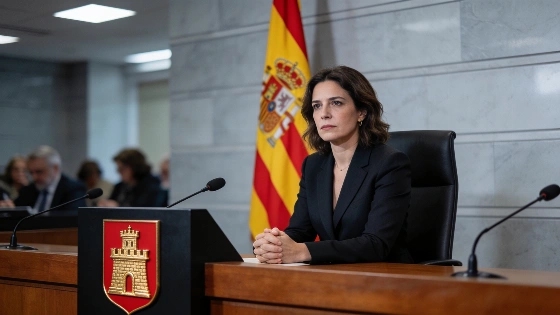
María de las Mercedes González Fernández, director general of the Guardia Civil, faces renewed political and judicial scrutiny over her contacts with former PSOE member Leire Díez. The Senate’s official agenda scheduled González to appear before its Interior Commission during the week of 19 to 25 October 2026 to provide information related to the commission’s work. The hearing puts her institutional decisions under parliamentary scrutiny, but does not determine the merits of the allegations or establish criminal responsibility.
The controversy, often described as the “cloacas del PSOE” case, concerns alleged efforts by people associated with Díez to influence or obstruct investigations involving Spain’s judiciary and Guardia Civil officers, including personnel from the force’s Unidad Central Operativa (UCO). Santiago Pedraz of Spain’s Audiencia Nacional is overseeing the judicial proceedings. González has been summoned as a person under investigation in connection with alleged prevarication and obstruction of justice. The court has yet to assess the allegations.
Reports on the inquiry say González acknowledged meeting Díez after initially denying the contacts, and maintained that she had informed Guardia Civil leadership about them. Two former UCO chiefs reportedly disputed that account before Judge Pedraz. Investigators are also examining the alleged deletion of messages between the women. González has denied taking part in any effort against the Guardia Civil, saying: “I have never, ever participated in any scheme against the Guardia Civil. It is my home, it is my family.” She has also reportedly told the judge that she did not take part in efforts to halt judicial investigations and considers herself a victim of Santos Cerdán and the network under investigation.
The inquiry’s wider cast includes Cerdán, along with lawyers Teijelo and Ismael Oliver. Guardia Civil Director Adjunto Operativo Manuel Llamas is also named, as is Juan Manuel Serrano, the former president of Correos and former chief of staff to Prime Minister Pedro Sánchez. A basic question is whether UCO officers handling investigations affecting Sánchez’s political environment faced pressure intended to weaken or stop their work. The allegations have not been established as findings of wrongdoing.
Written material attributed to Llamas and submitted to Judge Pedraz describes different reporting procedures for reserved internal investigations. It says González was informed about investigations involving the UCO, while three investigations in other units under the DAO were handled by Llamas and the relevant commanders, without notices being sent to her when they began or concluded. The same account says González ordered a second reserved UCO investigation and was fully informed about it. Llamas wrote that the director general had not been involved in the origin of those three other investigations and had no prior knowledge of their development.
Díez has declined to give a substantive public account of her meetings with González or say whether González warned her that the UCO was investigating her. “When I have something to say,” she said. Referring to Llamas, she added that she did not know “who the hell the DAO is.” Llamas holds the Guardia Civil’s senior operational leadership post as Director Adjunto Operativo.
González’s earlier career has also drawn attention as the case has developed. She studied journalism at Universidad San Pablo CEU, then completed master’s degrees in public and political communication at Universidad Complutense de Madrid and George Washington University. Her career included advising the Socialist groups in Madrid’s City Council and Assembly. She later directed communications at the Federación Española de Municipios y Provincias, served as a Madrid city councillor and government delegate, and sat in the Congress of Deputies.
The Guardia Civil is a national security force responsible for rural policing and counter-terrorism. Its director general leads the institution. The Senate appearance and separate judicial proceedings are distinct forms of scrutiny: the commission can question González about matters within its remit, while criminal allegations are subject to judicial determination.