Nancy de la Sierra and three relatives received Spanish nationality on 5 December 2023 under Spain’s Democratic Memory Law. Consular sources allege preferential treatment; her father and grandparents were born in Mexico.
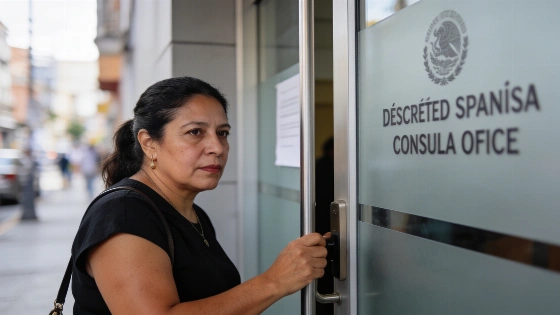
A consular message asked staff to give special attention to Nancy de la Sierra Arámburo and her elderly father at an appointment, according to documents reviewed by THE OBJECTIVE. On 5 December 2023, both received Spanish nationality. Two other family members received it the same day through the Ley de Memoria Democrática.
The family’s applications rested on an ancestry claim reaching beyond the senator’s grandparents. Her father, Óscar de la Sierra Said, was born in Mexico in 1939, as were both his parents. His father, José Manuel de la Sierra, was born in Puebla in February 1903; his mother was born in Mexico in 1909.
According to information obtained by the newspaper, Óscar de la Sierra submitted his parents’ marriage certificate and claimed that his grandfather was Spanish. The account says he did not provide a birth or baptism record for that ancestor. If the ancestor left Spain in the 19th century, as the claimed lineage would imply, that emigration took place decades before both the Civil War and the Franco dictatorship.
Spain’s Ley 20/2022, commonly known as the Democratic Memory Law or “grandchildren law,” provides several routes to nationality for descendants of Spaniards. One covers people born outside Spain whose parent or grandparent was originally Spanish and lost or renounced nationality because of persecution for political or ideological reasons. The law also covers religious persecution, as well as persecution based on sexual orientation or gender identity. Other routes apply to children of Spanish women who lost their nationality after marrying foreigners before the constitutional reform, and to adult children of people who acquired nationality under Spain’s 2007 or 2022 memory laws.
For applications based on a Spanish grandparent, Spanish consular instructions call for the applicant’s identity documents and birth certificate. They also require the Spanish ancestor’s birth certificate, along with the birth certificate of the parent linking the applicant to that ancestor. Applications relying on exile require supporting documents as well. An instruction signed on 25 October 2022 by then-director general for Legal Security and Public Trust Sofía Puente established a presumption of exile for originally Spanish citizens whose departure from Spain between 18 July 1936 and 31 December 1955 can be documented. The period specified in that instruction is distinct from the 19th-century emigration described in the family’s claimed lineage.
Consular sources consulted by THE OBJECTIVE allege that the family received preferential treatment during processing. The internal message described the appointment as one requiring staff attention so the senator could accompany her father. The documents also show that citizenship was granted to the father and his three children on the same date.
Lilia de la Sierra, born in Mexico in 1968, and Nancy de la Sierra, born in 1970, acquired nationality that day. Óscar de la Sierra, born in 1973, did as well. The report says the siblings’ children may apply through the same route once they are adults; it says their own children could obtain nationality through a civil registry procedure if they are minors.
Nancy de la Sierra began her political career in the Partido Revolucionario Institucional (PRI) and held posts in Puebla. From 1999 to 2004 she headed the Instituto para la Asistencia Pública de Puebla, then served as a state legislator from 2005 to 2008. She distanced herself from the PRI in 2017 and joined the Senate in 2018 through Juntos Haremos Historia, the coalition that backed Andrés Manuel López Obrador’s presidential bid. The coalition included Morena. The Partido del Trabajo (PT) was also part of it, as was the Partido Encuentro Social. On 3 October 2023, she announced her return to the PRI Senate group. Her term ended in 2024.
Consular sources say the case is part of a wider pattern and claim that 90% of people granted nationality under the law had no ancestor in Spain between 1936 and 1955. Separately, coverage of Vox and Sánchez has examined another strand of Spanish party politics.