A former Móstoles councillor has detailed three alleged sexual harassment incidents involving Mayor Manuel Bautista. She also described party pressure and lack of support after her internal complaint. The case has sparked protests and legal maneuvering.
The legal battle over alleged sexual harassment in Móstoles intensified this week as a former city councillor spent more than three hours before a judge, confirming her accusations against Mayor Manuel Bautista. The ex-councillor, who filed a criminal complaint in February, described in detail three separate incidents of sexual harassment and outlined what she called a pattern of workplace hostility and lack of support from the Partido Popular (PP) after she raised the issue internally.
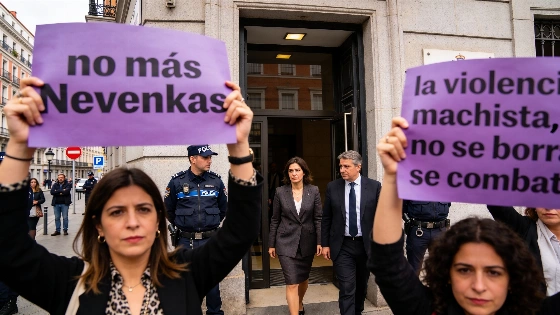
During her testimony at the local court specializing in violence against women, the former councillor answered questions from the judge, the prosecutor, and her own legal team. Outside the courthouse, a group of women demonstrated with purple banners bearing messages such as “no más Nevenkas” and “la violencia machista no se borra, se combate,” highlighting the public attention the case has drawn.
The complaint, filed on 16 February, accuses Bautista of sexual and workplace harassment, coercion, injuries, a crime against moral integrity, and breach of confidentiality. According to the ex-councillor, her attempts to address the issue through internal PP channels were ignored. The party’s national committee on rights and guarantees closed the case without notifying her or hearing from her witnesses, she stated.
Her account, as recorded in the complaint, centers on an initial episode involving explicit sexual propositions from Bautista, which she rejected. She claims this led to false rumors about a relationship between them and a subsequent work environment that made it impossible for her to perform her duties normally. The ex-councillor, recruited by Bautista in 2022 as his number two, ultimately left the PP after more than a decade of membership.
After the case was reported by EL PAÍS, Bautista publicly denied all allegations and refused to resign, suggesting the PSOE was behind the complaint. In court, he has sought to have the proceedings dismissed and has filed an appeal to that effect.
The former councillor also described efforts to seek help from PP leadership, including reaching out to Madrid regional president Isabel Díaz Ayuso. She recounted a meeting on 11 March 2024 at the party’s headquarters with Ana Millán and Alfonso Serrano, senior PP Madrid officials. According to her, she was pressured not to file a formal complaint, with party representatives urging her to “protect herself” by taking no further action. Audio recordings of this meeting have been submitted as evidence.
Following the meeting, the ex-councillor alleges that the party informed Bautista of her intentions, after which the mayor began contacting city councillors individually to gauge their loyalty. She described a deepening sense of isolation, as colleagues distanced themselves to avoid possible reprisals.
Cases of alleged sexual harassment involving public officials have become a focal point in Spain’s ongoing debate over workplace conduct and party accountability. Spanish law provides for specialized courts to handle gender-based violence and harassment cases, reflecting the country’s efforts to address such issues systematically. The outcome of the Móstoles case may influence how political parties respond to internal complaints and the level of protection offered to whistleblowers in public office.