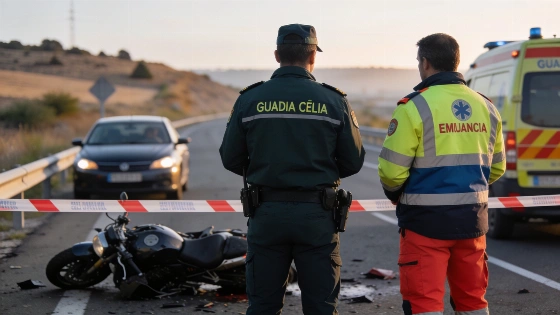
A crash on the N-620A near Villares de la Reina claimed the life of a young motorcyclist from Castellanos de Moriscos early Friday morning. The collision occurred at kilometer 233 of the highway and involved the victim’s motorcycle and a passenger car. Emergency services were alerted at 06:56, but medical personnel could only confirm the man’s death at the scene.
This was the second deadly motorcycle accident in Salamanca province in just 13 days. On August 8, another motorcyclist, a man in his 50s, died after losing control and overturning his bike on the SA-215 near Aldeanueva de la Sierra. In both cases, emergency teams, including the Guardia Civil de Tráfico and Sacyl medical staff, were dispatched immediately, but neither rider could be saved.
The two deaths come against a national backdrop of persistent motorcycle risk, including on conventional roads outside major cities. Spain recorded 286 motorcyclist deaths in 278 fatal crashes on interurban roads in 2024, information from the Dirección General de Tráfico (DGT). A longer-term DGT analysis counted more than 4,000 motorcyclist deaths and more than 330,000 injuries on urban and interurban roads between 2014 and 2023. Motorcycle fatalities rose 44% over that period.
National figures for 2025 recorded 1,775 road deaths across 103,591 reported crashes, 10 fewer deaths than in 2024. The DGT balance also recorded 9,888 people hospitalized, 327 more than the previous year. Motorcyclists accounted for 436 deaths: 304 on interurban roads and 132 in urban areas, nearly one-quarter of all road fatalities. In urban areas, vulnerable road users made up 81% of fatalities; motorcyclists alone accounted for 26% of those deaths.
DGT Director General Pere Navarro has put the scale of the problem at around 500 motorcyclist deaths annually across urban and interurban roads. Speaking at the II International Motorcycle Road Safety Conference in Zaragoza, promoted by the DGT and the Asociación Nacional de Empresas del Sector Dos Ruedas (Anesdor), Navarro called that toll “an absurdity” and argued that monitoring and control, backed by sanctions, are basic tools for reducing violations. The figures help explain the focus of road safety discussions: overall fatality totals, rider exposure and speed management, alongside road design and awareness among all road users.
Similar concerns have been raised elsewhere in Spain, including after a 74-year-old pedestrian died when struck by a car on Avenida de América in Madrid. That incident, detailed in this report, also prompted questions about accident prevention and emergency response times in urban areas.
Early-morning travel can pose particular challenges for motorcyclists on regional highways such as the N-620A, where visibility may be reduced and traffic mixed. The two Salamanca crashes occurred in different locations and under different circumstances, yet both resulted in a rider’s death within less than two weeks. Their impact has renewed attention to the risks motorcyclists face on the province’s roads and to the wider national debate over effective prevention measures.