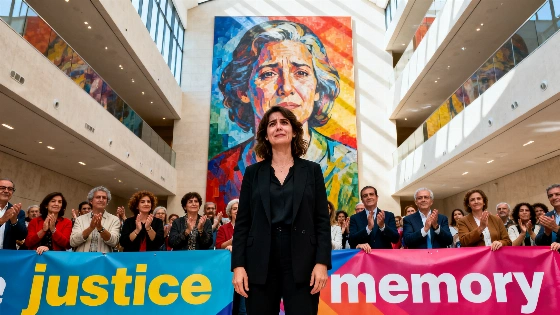
Nevenka Fernández returned to Ponferrada this Saturday for her first public appearance in the city since leaving Spain more than two decades ago. She attended the “Justicia, Voces y Memoria” forum, an event focused on justice and collective memory that also renewed attention to sexual harassment and political power in public life.
Held at La Térmica Cultural, the forum brought together local and regional figures, including Sara Aagesen, Spain’s third vice president and Minister for the Ecological Transition and Demographic Challenge. Fernández, a former Partido Popular councillor in Ponferrada, was welcomed with applause and visible support from attendees. Carlos Martínez, secretary general of the PSOE in Castilla y León, was among those who greeted her, reflecting the case’s significance beyond party lines.
Fernández left Spain more than 20 years ago after publicly denouncing sexual harassment while in office. In 2001, she accused Ponferrada’s then-mayor, Ismael Álvarez, who belonged to the same party and municipal political group. Álvarez was convicted in 2002; the case has since been described as Spain’s first conviction of a politician for sexual harassment. The forum gave Fernández a platform to address justice and public memory, while recalling the consequences faced by people who speak out against abuse by those in positions of power.
During the event, Fernández joined Aagesen in unveiling a mural. Residents and family members responded warmly, showing that the case still resonates in Ponferrada and beyond. Public recognition and remembrance formed part of the forum’s broader focus on how institutions and communities respond to past injustice.
The case predates Spain’s basic modern statutory structure for preventing workplace sexual harassment. Organic Law 3/2007 distinguishes sexual harassment from harassment based on sex and, under Article 48, requires employers to promote conditions that prevent both and establish procedures for handling complaints. Organic Law 10/2022 later reinforced employers’ preventive and complaint-handling obligations, including procedures that apply regardless of company size and cover digital conduct. These measures set out a more explicit institutional structure than the one in place when Fernández brought her complaint in 2001.
Spanish equality law also recognizes both forms of harassment as discriminatory conduct. Article 7 of Organic Law 3/2007 defines sexual harassment as verbal or physical conduct of a sexual nature that violates dignity or creates an intimidating, degrading or offensive environment. The Workers’ Statute recognizes workers’ right to protection from sexual harassment and harassment based on sex, and provides for disciplinary dismissal of those who commit either form. Fernández’s return to Ponferrada so connected a landmark case in public life with continuing questions about prevention and accountability, including how people who report harassment are supported.
The case has also been revisited in theatre. María Goiricelaya’s play Nevenka, performed by Gema Matarranz, Alex Furundarena and Ana Ibáñez, reconstructs the events around Fernández’s complaint and examines power and justice, including the silence surrounding the case. Its cultural afterlife reflects the continuing place of her story in Spain’s debate about harassment and collective memory.