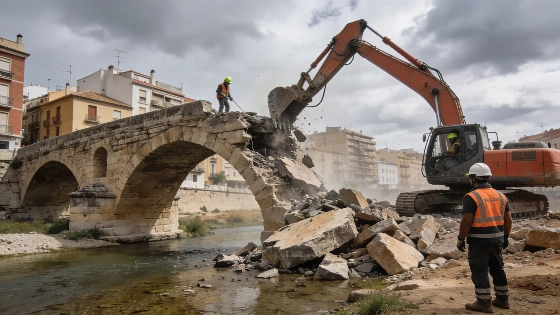
Paiporta has begun demolishing Pont Vell, the town's century-old bridge, after the October 2024 DANA exposed serious structural problems. Officials opted for a full replacement over repairs, saying a new bridge is needed to improve safety and carry more water during floods. The Ministry of Transport is overseeing the work, which is expected to take about a month.
The floods hit Paiporta especially hard. Technical reports found that Pont Vell had reached the end of its useful life and that restoring it would not meet current safety standards, particularly after the storm. Local authorities concluded that only a new bridge could meet modern requirements.
Local press reports put the budget for the new bridge and pedestrian walkway at around 9 million euros, with funding secured from the EU's Plan EDIL-DANA.
The new bridge will increase hydraulic capacity by 45 percent, mainly by reducing the number of supports and improving its alignment with the river. Its conical piers are designed to let water pass more easily, and the structure will be better prepared for future floods. At 8.5 meters wide, it will be one meter wider than the old bridge, improving safety for traffic and pedestrians. The changes follow engineering recommendations and lessons from recent storms.
Mayor Vicent Ciscar described it as a day of mixed feelings for Paiporta. He acknowledged the bridge's importance to daily life and local memory, but said the DANA made clear that restoring the old structure was not an option. Technical and safety needs shaped the new project, which will also include elements recalling Pont Vell's heritage and the town's history.
Before demolition began, the town made sure residents could still cross the barranco by other routes, including Pont Nou and the Puente de la Estación, as well as the pedestrian walkway on carrer Convent. These alternatives were intended to limit disruption during construction. Over the summer, the municipality held public meetings to explain why the bridge was being demolished and outline the new design, while addressing concerns and emphasizing public safety.
Regional press reports describe the demolition as part of a broader post-DANA recovery campaign in Paiporta. Authorities have prioritized restoring mobility before replacing the most vulnerable structures. In neighboring Riba-roja de Túria, the historic bridge is being rehabilitated for 1.5 million euros, preserving its “historic scars.” That reflects a different approach to managing the region's infrastructure.
The Pont Vell project feeds into a wider regional debate over how to handle aging infrastructure after disasters. In Chiva, for example, a newly rebuilt bridge flooded soon after opening, raising questions about the durability of emergency repairs. For towns like Paiporta, the challenge is to preserve history while keeping people safe.
As extreme weather becomes more frequent, Paiporta's decision reflects a shift toward adapting to new risks. The town is letting go of a familiar landmark to build a safer, more resilient bridge. That approach differs from patching up old structures and could offer a model for other towns facing similar choices.