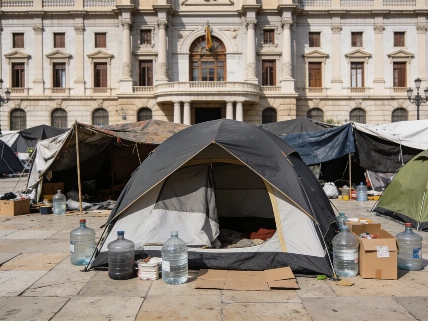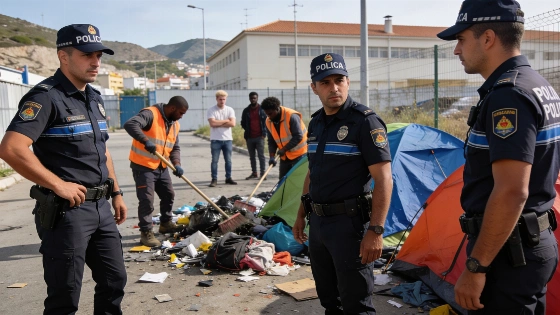
Police in Ceuta moved in early Monday to dismantle a makeshift migrant camp beside the Loma Colmenar reception centre. Tensions had escalated that morning as hundreds of migrants gathered outside, hoping to enter. Local sources said officers fired warning shots into the air to break up violent confrontations among migrants as new arrivals tried to join the queue.
The unrest began around 8 a.m., when staff at the Loma Colmenar centre, which operates under the Ministry of Migrations, began admitting more migrants. The sudden influx drew people from other parts of the city and overwhelmed efforts to process them in an orderly way. Rafael García, president of the Loma Colmenar neighbourhood association, described the situation as chaotic: the usual line system collapsed, and physical strength determined who moved forward.
Loma Colmenar and Loma Margarita were among the first sites the government designated to shelter migrants who entered Ceuta irregularly during the mass crossings at the end of July. Since then, the city has expanded its emergency accommodation capacity to 3,300 places, as Prime Minister Pedro Sánchez confirmed. That total includes 1,200 spots at Loma Colmenar and 1,300 at Loma Margarita, along with 500 to 600 places through the extension of the Temporary Stay Centre for Immigrants and 320 at the Hípica facility, reserved for women and children.
After the police intervention, municipal workers cleared debris and waste left by the camp’s dismantling. Neighbourhood representatives said approximately 800 migrants were admitted to the Loma Colmenar centre, while the rest were dispersed to other locations across the city. The rapid escalation shows the strain on Ceuta’s resources and the difficulty of managing large-scale arrivals.
The incident comes as Spanish authorities step up efforts to simplify migrant processing in Ceuta. Spain recently formally requested support from EU agencies to accelerate identification and asylum procedures, as detailed in a recent report on Spain’s appeal for Frontex and Europol assistance. The city’s proximity to Morocco and its role as a basic entry point to Europe keep it at the centre of migration policy and emergency response.
Ceuta’s experience reflects wider migration pressures at Spain’s external borders. Sudden surges have repeatedly tested the city’s reception infrastructure, forcing local authorities to adapt quickly. The government is expanding temporary accommodation and coordinating with European partners. National and European institutions continue to monitor Ceuta closely.