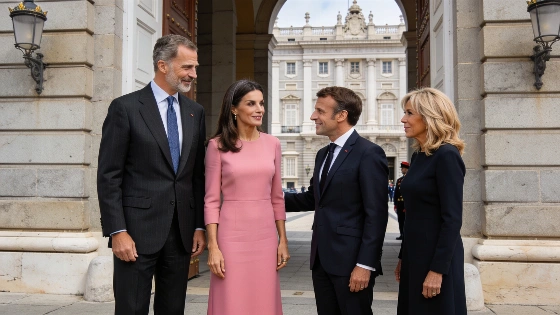
Emmanuel Macron and his wife, Brigitte, arrived in Madrid for a rare state visit. King Felipe and Queen Letizia met them at the Royal Palace, led the ceremonies and hosted the gala, while overseeing diplomatic details. Princess Leonor, the 20-year-old heir, was absent.
This was not a scheduling issue. Leonor studies political science at Universidad Carlos III in Madrid, and some expected her to take a bigger role at major state events. The royal household had made no such promise, confirming only that she would continue her current institutional duties. Official information from the Spanish Royal Household showed that the program for Macron’s visit on September 29-30, 2026, listed only the King and Queen as hosts; no events included Princess Leonor or Infanta Sofia. The visit was the first official trip to Spain by a French president since Nicolas Sarkozy in 2009.
Protocol expert María José Gómez Verdú, author of ‘Protocolo POP’, sees Leonor’s absence as intentional, not a mistake. “Her absence in the recent visit of the Macrons has reignited debate about her involvement in major institutional events,” Gómez Verdú says. She believes protocol would allow Leonor to attend some official or cultural events, giving her real experience with the duties she will one day take on.
But not every royal event needs the heir. “A state visit does not necessarily involve all members of the royal family. These are structured occasions where the Kings act as hosts and the meetings serve specific diplomatic objectives,” Gómez Verdú explains. The palace gave no official reason for Leonor’s absence, which is normal and does not mean she is being sidelined. The focus is on how she is gradually being brought into the royal agenda. Spanish media, citing the published program, confirmed that neither Princess Leonor nor Infanta Sofia was scheduled for any part of the visit.
Every time Leonor appears in public, it is a careful decision. “In protocol, presence is not about quantity. It’s about appearing in the right context with a clear function,” Gómez Verdú says. She notes that a gala dinner could become a turning point for Leonor’s public role, but only once her responsibilities in international relations and royal representation have grown. Gala.fr reported that President Macron made a special mention of Princess Leonor and Infanta Sofia in his toast at the official gala dinner, acknowledging their status despite their absence. The gesture showed that their absence was noted and respected in the official rhetoric.
For now, the royal plan is simple: every public role Leonor takes must have meaning. Gómez Verdú suggests she should appear more often at international events focused on culture and education, including programs involving science or young people. That would help her build a real profile instead of simply accompanying the Kings. The aim is to give her a clear agenda suited to her future as queen, with appearances chosen selectively.
As reported in previous analysis by Russpain, the Macrons’ visit showcased Franco-Spanish ties at a tense time for France. The heir’s absence from such a high-profile event stands out, but protocol rules the day.
Leonor’s basic focus now is her university studies. Gómez Verdú says her readiness for the throne will be judged by the meaning and timing of each appearance, rather than by how often she appears in public. In a monarchy, symbolism and timing matter more than being seen everywhere. The Spanish royal household is sticking to a plan: Leonor’s public image will grow step by step, and each appearance will strengthen her position as heir. Overexposure is not the goal.