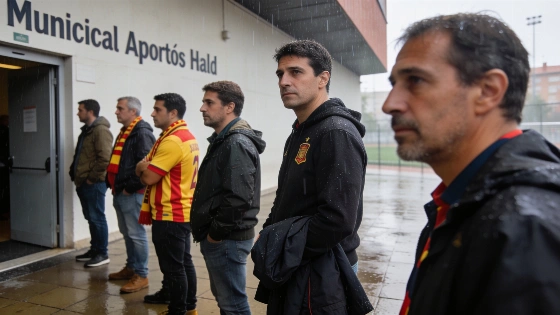
Queues stretched for more than three blocks around Polideportivo Los Cantos as supporters waited in cold rain to get inside. Ara described a queue of roughly half a kilometre shortly before the event. Dozens of PSOE members who had travelled to Pedro Sánchez’s rally in Alcorcón could not enter the main hall.
Security sources at the sports centre said the first people to fill the stands had arrived on buses from other PSOE groups. Party organisers put the venue’s capacity at about 5,000, while Público reported attendance of more than 5,500. Many supporters inside wore red wristbands, including people in the upper areas and those seated in the centre of the venue.
Organisers opened a second room, or annex, with screens for some of those waiting outside, although they had not initially planned to use it. Many people stood in the overflow area, but most still could not get in. El Mundo reported that several buses bringing supporters from other municipalities had to turn back because the sports centre could not accommodate everyone. Supporters crowded the entrance asking for explanations as the queue stretched beyond the venue and out of sight.
Some people waiting said they had been standing in the cold and rain for a long time. Others objected that supporters from outside Alcorcón had entered while local members remained outside. One woman said: «Yo soy de aquí y también quiero ver a Sánchez» (“I am from here and I want to see Sánchez too”, translated from Spanish).
The access problems followed a similar complaint at a PSOE event in Valencia, where hundreds of party members said they had travelled by bus from other groups and could not enter despite receiving wristbands. One socialist who was unable to get inside called it «Ha sido un desastre» (“It has been a disaster”, translated from Spanish). RUSSPAIN.COM has also covered Sánchez’s backing for the 11N general strike in earlier strike coverage.
The Alcorcón rally took place on 15 November, during the campaign for the 29 November general election, and served to present the PSOE’s programme, titled “La fuerza de seguir avanzando”. The party had not unveiled it when its campaign began in Seville on the preceding Thursday. The programme set out proposals on wages and affordable housing, alongside plans for public services and taxation. Cristina Narbona, the PSOE president, oversaw its preparation.
Among Sánchez’s proposals were a new legal category for people who care for one another but are not married, domestic partners or relatives, and a four-week Social Security benefit at 100% of the regulatory base for parents caring for children under eight. The programme also proposed constitutional protection for annual pension revaluation and the right to abortion, alongside higher taxes on large investment funds and major property owners. These were campaign proposals, not measures already in force.
Begoña Gómez, the prime minister’s wife, had appeared as a speaker at the campaign launch in Seville and also took part in the Alcorcón presentation, where she defended feminism and equality policies. At the Seville launch she said she wanted to speak from the lectern as a «militante de base del PSOE» (“grass-roots PSOE member”, translated from Spanish).
At the Alcorcón event, Sánchez was accompanied by ministers and members of his Moncloa team. Besides the prime minister, only two people spoke: Candelaria Testa, the town’s mayor, and Óscar López, secretary-general of the Madrid Socialists and minister for Digital Transformation and the Civil Service. Sánchez called for a “historic mobilisation” ahead of the election; Público reported that he set a target of 75% support among progressive voters and linked it to a goal of 176 progressive parliamentary seats.