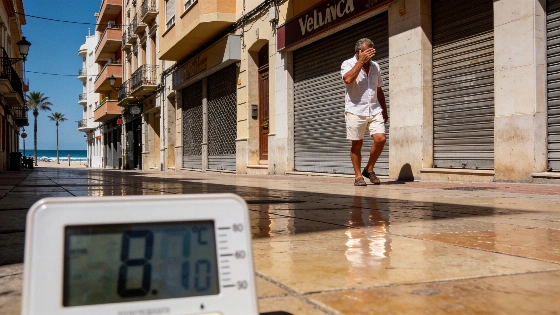
Spain is bracing for a dangerous heatwave as the Agencia Estatal de Meteorología (AEMET), the country’s official meteorological agency, has declared a red alert for the Comunidad Valenciana, warning of forecast temperatures reaching 44°C in southern coastal areas. The highest level of weather warning will be in effect from 13:00. The northern coast of Valencia is also expected to reach 43°C, while the Alicante coast is forecast to hit 40°C. These are forecast maxima for specific coastal areas; AEMET publishes station observations separately, including hourly readings and daily extremes, so forecasts and temperatures actually recorded are distinct measures. The agency’s warning system assigns alerts by geographical zone and hazard, rather than treating every municipality in a region as facing identical conditions. Authorities are urging residents to take precautions.
Alongside Valencia, five other regions, Aragón, Andalucía, Castilla-La Mancha, the Región de Murcia, and Cataluña, are under orange alerts due to impressive heat risks, storms, and heavy rainfall. In Andalucía, Almería province is set to experience the worst conditions, with temperatures likely to reach 40°C in the Almanzora and Los Vélez valleys and 39°C in eastern Almería. Southern Huesca and Bajo Aragón in Aragón are also expected to reach 40°C, while temperatures in Albacete, Castilla-La Mancha, are forecast to range from 34°C to 39°C. This zone-based approach reflects the sharp differences that coastal, inland, mountainous and valley locations can experience during the same weather episode.
Cataluña faces a dual threat: intense heat across the region, along with strong storms and heavy rain forecast for the Pyrenees, the pre-coastal areas, and the Ampurdán in Girona. Rainfall could reach 20 liters per square meter in just one hour, equivalent to 20 millimeters, sometimes accompanied by strong winds and hail. The Región de Murcia is also under orange alert, with temperatures around 40°C expected in the Valle del Guadalentín, Lorca, Águilas, the northwest, and the Altiplano. AEMET’s warning structure covers heat, heavy rain, storms, wind and hail, allowing different hazards to be flagged in separate areas at the same time.
Beyond these high-risk zones, AEMET has issued yellow alerts for Baleares, Castilla y León, Galicia, Comunidad de Madrid, Navarra, País Vasco, and La Rioja. These warnings mainly concern elevated temperatures. In Castilla y León, but, León province, especially the Cantabrian mountains, could see heavy rain and storms, with rainfall of up to 15 liters per square meter, or 15 millimeters, and the possibility of hail and strong gusts.
Spain’s weather services have intensified their warnings as the country faces a summer marked by frequent heatwaves and unpredictable storms. The current situation echoes recent weather disruptions in other regions, such as the Canary Islands, where rising temperatures and strong winds have also prompted official alerts, as reported in coverage of the Canary Islands' recent weather shift. AEMET’s observation network reports conditions at individual stations, including locations such as Valls in Tarragona and San Fernando in Cádiz, providing local readings rather than a single figure for an entire region. These patterns highlight the growing challenges for local authorities and residents as they adapt to increasingly volatile summer conditions.
Heatwaves in Spain have become more frequent and intense over the past decade, often disrupting daily life, increasing health risks, and putting pressure on emergency services. The red alert in Valencia is the highest warning level, reserved for situations of extraordinary danger to health and safety. Residents in affected areas are advised to avoid outdoor activities during peak heat, stay hydrated, and monitor updates from local authorities. High temperatures combined with sudden storms can also affect transport, agriculture, and energy demand, making a coordinated response impressive. As climate patterns shift, such extreme weather events are expected to remain a critical concern for Spain’s regions throughout the summer months.