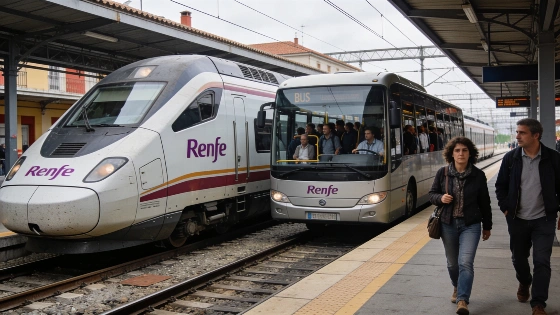
Renfe relaunched its tender for a new coach service in October 2026, dividing it into 14 lots, after the procurement was suspended in April. The tender is intended to provide road transport for passengers when rail services are disrupted by incidents or planned works. The Tribunal Administrativo Central de Recursos Contractuales (TACRC) halted the process after appeals by Direbús and other bus-sector groups, including Anetra and Fenadismer. In a ruling in July, the tribunal said alternative transport plans are connected to railway activity whether they respond to unexpected disruptions or scheduled works. It required changes to the procurement design, covering the lot structure and bidder solvency requirements, as well as minimum vehicle availability and contract duration.
The tender began in March 2026. Its relaunch came as the presence of former bus-industry executives at Renfe raised questions among unions and employees, according to ABC. The newspaper says more than 20 people linked to political groups or bus companies joined the public operator after Álvaro Fernández Heredia became its president in January 2025. At least 15 had no experience in rail, the report says. Renfe unions reportedly counted 50 appointments and organisational changes during Heredia’s first year as president. El Correo separately reported 28 incorporations during his first seven months and associated expenditure of €2.5 million.
Heredia is a civil engineer with a doctorate in transport infrastructure. His career focused on urban transport: he managed Madrid’s EMT from 2015 to 2019 under Mayor Manuela Carmena, then led Valladolid’s AUVASA from 2019 to 2023, when Óscar Puente was mayor. He became Renfe president in January 2025, while Puente was transport minister. Reports have described the wider personnel reshuffle across Renfe and Adif as involving roughly 20 people linked to Puente and Heredia, as well as figures associated with Ximo Puig or the PSOE, in senior transport-system roles.
Some appointments came from political circles. ABC identifies José María Vicent, from Más Madrid, as Renfe’s secretary-general and secretary to its board. Sources at the company told the newspaper that the post was tailored for him after a requirement for a state lawyer was removed. Vicent joined in July 2026 and, according to the report, had no railway-sector experience. El Correo reported that Vicent had previously served as secretary-general technician in Madrid’s Environment and Mobility area.
María del Mar de los Reyes Montiel Mesa, described by ABC as a personal friend of Heredia, became communications director. She had been an MP in the Madrid Assembly and a co-spokesperson for Equo; the report says she lacked experience in the sector. Ismael Bosch, who had worked as Puente’s chief of staff in Valladolid, joined the Renfe Viajeros board in 2025. Five PSOE-affiliated figures were already at Renfe when Heredia arrived, and sources told ABC that they were among the few to remain after the changes.
The newspaper also details appointments tied to bus companies. José Alfonso Gálvez Salinas, who had worked at AUVASA with Heredia, became Renfe’s director-general for business and operations. Antonio García Pastor, an engineer who had worked at Avanza, was appointed director of global strategy; sources cited by ABC described him as close to Heredia. The report says five former executives came from Avanza and Alsa, and also names Grupo Interbus.
Other cases include Rafael Cortés, who moved from a senior role at Avanza to Renfe in 2024 and left in 2025. ABC says he had no railway experience. Christian Muñoz Monge, formerly technical director of the Granada metropolitan transport consortium for 18 years, also joined Renfe; the report says he lacked knowledge of the rail sector.
ABC presents the appointments as a political influx alongside the arrival of bus-sector figures. It also reports that the coach tender was relaunched in October after the April suspension prompted by Direbús’s appeal. Renfe’s revised 14-lot structure followed the TACRC’s intervention and was presented as a way to facilitate participation by smaller bus companies.