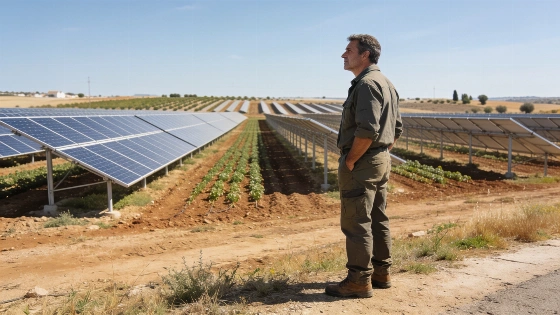
When José Portillo agreed to lease 15 hectares of his farmland in Carmona, Seville, for a large-scale photovoltaic plant, his income changed overnight. He once grew wheat and chickpeas, alongside sunflowers. Now Portillo receives €1,900 per hectare, far surpassing the €100 he previously earned from each harvest. His story, detailed in a 2023 broadcast of Equipo de Investigación, reflects the opportunities and trade-offs as solar energy expands across rural Spain.
Portillo’s case stands out for its reported figures: a 19-fold increase, from €1,500 to €28,500 across the 15 hectares. The payment frequency and contractual terms were not specified, so the figures should not be treated as annual net income. A landowner weighing a lease against farming also has to distinguish gross rent from farm profit and account for taxes, operating costs, land-restoration obligations, contract duration and what happens if a project does not proceed. Solar lease values can vary with project conditions, including grid access and permitting risk, as well as parcel size and design. A study published in Sustainability notes that lower land purchase or rental costs can reduce the overall cost of large solar plants and improve their profitability.
Not every landowner is eager to make the switch. Decisions can hinge on more than the size of an offer, including a farmer’s attachment to the land and the property’s future use. A separate report linked in this coverage concerns a case involving agricultural compensation, distinct from Portillo’s lease.
Changing Field
As Carmona draws interest in solar development, projects in Andalusia move through a regulatory process involving the regional government and publication of administrative decisions in the Boletín Oficial de la Junta de Andalucía (BOJA). Authorization is one stage of a project’s development. Construction, further permits and commissioning must follow before a plant can supply electricity to the grid.
Spain’s renewable-energy sector also makes a impressive contribution to the national economy. APPA Renovables and Deloitte’s 2025 macroeconomic study reported that renewables contributed €17.501 billion to Spain’s gross domestic product and supported 140,621 jobs that year. Those national figures describe the sector’s wider economic footprint, not landowner returns, agricultural displacement or the value of any particular lease.
Debate over local costs and benefits continues. In 2026, the photovoltaic industry association UNEF criticized a proposed solar-park tax in Castilla y León as “revenue-raising and unjustified,” arguing that it could deter investment and affect businesses and consumers. A media report also estimated that municipalities hosting solar parks receive about €10,000 in annual local economic activity and tax contributions per installed megawatt. That estimate concerns public and local economic effects, not private land rent.
Alternatives and Adaptation
Leasing farmland to solar developers is not the only possible model. Agrivoltaics combines agricultural production with solar generation on the same land, using panel layouts designed to leave room for cultivation. Its practical and economic performance depends on local conditions, including shade, machinery access and crop choice.
Other rural land-management approaches can combine energy infrastructure with agricultural activity. Sheep grazing, for example, can manage vegetation around solar installations while also helping reduce the fuel available to wildfires.
Portillo’s experience shows the financial appeal a solar lease can hold for some landowners, while highlighting the importance of contract terms and the distinction between rental income and farm profit. Across rural Spain, decisions to lease land or continue farming are shaped by economics, land use and agriculture’s changing role in the energy transition.