Smart is preparing to re-enter the spotlight with the smart #2, a compact electric two-seater that brings the brand back to its urban roots. The model is scheduled for its world premiere at the Paris Motor Show on October 26. It revives the city-car identity associated with the original smart fortwo after the brand’s expansion into larger vehicles, including the smart #5. In October 2026, the production version completed final assembly at Geely’s Jinan manufacturing base in China, moving beyond prototypes and testing into series manufacturing.
Developed through the smart joint venture between Mercedes-Benz and Geely, the #2 has Mercedes-Benz-led global design. Its return to the two-seat format contrasts with the brand’s recent focus on larger vehicles, giving it a more specific urban role than compact electric cars such as the Renault 5. The smart #2 is designed for two occupants and measures approximately 2.75 metres long, dimensions intended to make manoeuvring and parking easier on dense city streets.
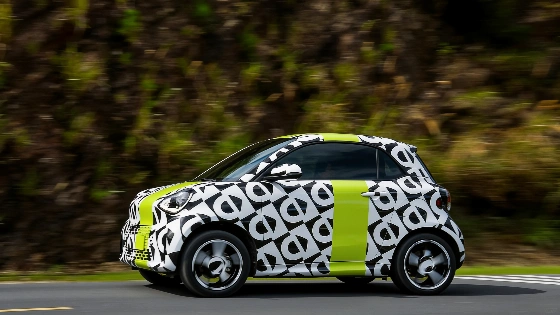
Prototypes of the smart #2 have been seen in public wearing black-and-white camouflage designed by Mercedes-Benz’s global design team. Smart says it has tested the car extensively on specialist circuits and city roads, simulating sudden obstacles and emergency lane changes, including in wet, low-grip conditions. The development programme has focused on chassis response, steering and suspension, aiming to combine stable handling with the agility expected of a small city car.
Comfort and Silence at the Core
Smart has made interior comfort a priority alongside the car’s compact design. The development programme included noise, vibration and harshness (NVH) validation in wind tunnels and acoustic chambers, as well as temperature-controlled four-post test rigs and public roads. Engineers focused on reducing wind and road noise, refining powertrain acoustics, and addressing unwanted rattles and squeaks.
Testing also covered rolling performance and durability. Smart’s engineers evaluated tyre compounds on rough asphalt and grooved concrete, then tested them on high-speed straights, seeking a balance between low rolling resistance and reduced noise. The car also faced uneven roads and urban hazards such as curbs and deep potholes, tests designed to assess its ability to withstand the repeated impacts of daily city use.
The smart #2 is built on a newly developed Electric Compact Architecture (ECA). Smart says the platform combines rear-wheel lead with a five-link rear suspension, a layout the company describes as a first for the ultra-compact segment. The car retains a rear-mounted electric motor and rear-wheel-lead configuration, while European technical reporting lists output of about 82 horsepower and a turning diameter of 6.95 metres. Smart has also highlighted improvements to chassis rigidity and structural stress points, along with a new generation of its tridion safety cell.
Reported battery and range figures vary by market and test cycle. European reporting puts the battery at 35.7 kWh and estimated range at up to 290 kilometres under the WLTP cycle; figures reported for China are 35.8 kWh and up to 410 kilometres under CLTC. These estimates use different testing methodologies and are not directly comparable. The figures position the car primarily for urban and shorter-distance travel, rather than long motorway journeys.
Urban EVs on the Rise
The smart #2’s Paris Motor Show debut brings the brand’s two-seat city-car format back to a European market with a growing range of compact electric vehicles. Smart presented the model as a return to its urban identity, while CEO of smart Europe Wolfgang Ufer described it as “not merely a new model, but the return of a true automotive icon.” The company also introduced a limited gilded special edition capped at 999 units, with deliveries planned before the end of 2026.
In China, the market launch is scheduled for November 5, 2026, with a Premium version planned for early November and deliveries expected in the fourth quarter. The limited passenger and cargo capacity of a two-seat layout sets the #2 apart from larger electric hatchbacks and SUVs. Its appeal will depend on how buyers weigh that trade-off against its small footprint and manoeuvrability. The shift toward compact electric mobility is also evident in other manufacturers’ strategies, including the Kia EV2 GT-Line, praised for its agile city performance and clever features, though it has its own limitations on longer journeys (read more about the Kia EV2 GT-Line here).
With compact dimensions and rear-wheel lead paired with an all-electric powertrain, the smart #2 aims to bring the brand’s original city-car proposition into a new era. Its Paris debut and planned Chinese launch put the two-seater back at the centre of Smart’s urban-car identity as competition in the electric city-car segment grows.