Spain has spent just a quarter of €401 million in EU funds for wildfire prevention since 2022. Most projects remain incomplete. Regional governments handle most spending, while key state initiatives stall.
Spain has executed only a fraction of the €401 million in European funds allocated for wildfire prevention and forest management since 2022, leaving the majority of projects unfinished as the country faces another challenging fire season. According to official data, just €103–106 million has been spent, covering interventions in roughly 120 out of more than 310 planned projects. This leaves 190 initiatives, representing €295 million, still awaiting implementation.
The responsibility for managing these funds has largely fallen to Spain’s autonomous communities, which have overseen 58% of the executed budget. In contrast, the central government has directly managed only €28 million, with the remainder handled by various public entities and, to a lesser extent, local authorities. The slow pace of execution is particularly notable given the urgency of wildfire threats and the scale of recent disasters.
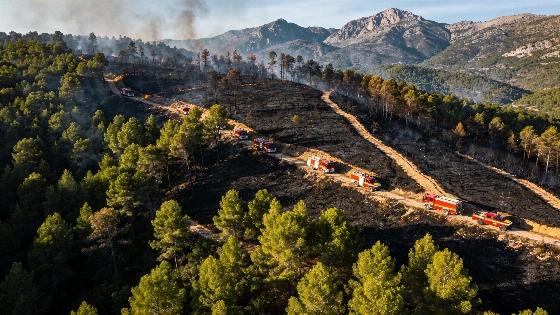
The projects funded under this initiative range from modernizing firefighting aircraft and purchasing new fire engines to improving forest tracks, creating firebreaks, clearing undergrowth, and restoring habitats. Notably, the largest single project—€22 million earmarked for renewing ten aging Canadair firefighting planes—remains unresolved after a failed procurement process. The Ministry for Ecological Transition canceled the tender four years after its launch due to procedural errors, leaving the future of these funds uncertain.
Other planned investments include the acquisition of 40 fire engines for €12 million and a series of smaller-scale actions, most of which are managed by regional governments. Despite the scale of the challenge, the pace of spending has been uneven: the largest outlays occurred in 2022 and are projected for 2025, with €40–50 million spent in each of those years, compared to just €6 million in 2024 and a little over €3 million so far this year.
These efforts are part of the fourth component of Spain’s Recovery Plan, focused on ecosystems and biodiversity, which is backed by €1.643 billion and subdivided into four investment lines, including wildfire prevention and forest management. The original targets for this component were softened during the renegotiation of the Next Generation EU funds addendum in 2023, shifting the focus from aerial firefighting resources to broader goals such as digitalization, mapping, and biodiversity restoration.
The Independent Authority for Fiscal Responsibility (AIReF) has raised concerns about the lack of reliable data to assess the true fiscal cost of wildfires. Between 2005 and 2025, the government’s direct fiscal response to wildfires—including reforestation aid and compensation—amounted to just €615 million, heavily influenced by catastrophic events like the 2005 Guadalajara fire and the 2006 Galicia fires. However, the intangible losses to nature and communities remain incalculable.
AIReF also notes that its observatory tracks only tenders and subsidies, meaning additional investments may exist through other financial instruments. The absence of comprehensive data complicates efforts to evaluate the effectiveness of public spending on wildfire prevention and recovery.
As Spain approaches the end of the EU funding period, the risk of unspent resources looms large. The country’s experience highlights the challenges of translating ambitious funding commitments into concrete action on the ground, especially when coordination between national and regional authorities is required. The issue of underutilized public funds is not unique to wildfire prevention. For example, recent analysis has shown that frequent switching off of air conditioning systems in Spain can inadvertently increase electricity bills, as discussed in this report on energy efficiency and household costs.
Spain’s struggle to fully deploy EU wildfire prevention funds comes at a time when the country faces increasingly severe fire seasons, with burned areas already approaching record levels before August. The combination of administrative delays, shifting priorities, and incomplete data leaves both forests and communities exposed to ongoing risks, underscoring the need for more effective management and transparent reporting in the years ahead.