Counting the 2013 Angrois crash puts the death toll at 195, though it happened on a conventional line. The train involved was an Alvia, which is counted as a high-speed train. The July 2013 derailment near Santiago de Compostela remains a reference point in discussions about railway safety and accountability. After the crash, the European Commission opened two infringement procedures against Spain over alleged failures to meet railway-safety requirements.
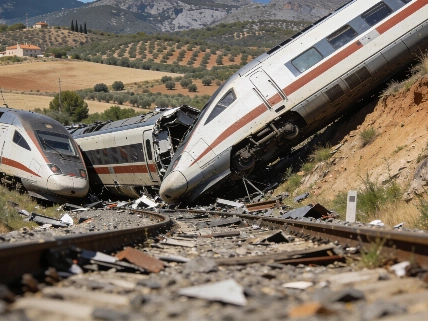
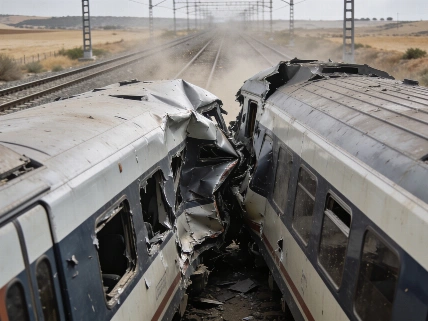
The disasters at Adamuz and Urda account for 115 deaths. The January 2026 Adamuz collision near Córdoba involved Iryo and Renfe trains and killed 46 people; the formal investigation was still underway when the Urda crash occurred. On this basis, Spain has the highest toll in the European Union from accidents involving high-speed trains.
The way the total is counted matters. Angrois was not a high-speed line accident, while the train itself was classified as high-speed. A similar distinction applies to Eschede in Germany: in 1998, 101 people died after a wheel on an InterCityExpress broke on a conventional line modernised for speeds of up to 200 km/h. Comparisons can also vary depending on whether they count high-speed rolling stock or dedicated high-speed infrastructure, as well as passenger services and test operations.
The European Commission's report says Spain's rail services have relatively low intensity of use compared with France. Italy and Belgium are also among the countries used for comparison. The report found no saturation problem.
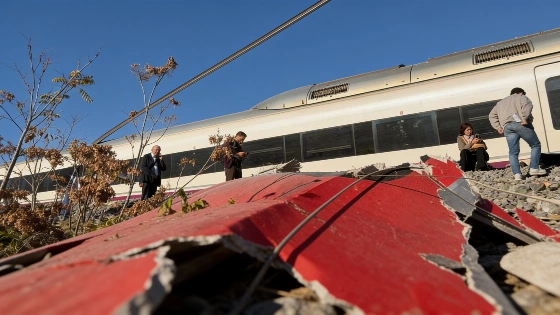
Elsewhere in the EU, two train drivers died when a train derailed at a switch in Livraga, Italy, in 2020. France recorded 10 deaths in 2015 when a test train crashed near Estrasburgo. The TGV has had no fatal accident in service since its inaugural journey in 1981. An earlier Urda report described families searching for missing passengers. The Urda collision took place on 28 October 2026 near Toledo, on the Madrid-Seville high-speed line, when a Renfe train collided with a stationary Iryo train. Reported totals reached 68-69 dead and more than 100 injured, bringing the combined death toll from the Adamuz and Urda crashes to 114-115. Preliminary accounts described a signalling or control-system failure; one reported reconstruction said the Renfe train travelled about 25 kilometres before the collision. Investigators were still working to establish the precise causal chain. By 29-30 October, the Guardia Civil had questioned the Adif operator who authorized the train to proceed. The two crashes made Urda the second fatal accident involving high-speed trains on the same corridor in 2026.