The European Union still depends largely on imported natural gas, while Spain injected just 316 GWh of biomethane into its grid in 2024. University of Valladolid researchers set out the contrast with the country’s estimated potential of more than 100 TWh a year in RETEMA’s 2026 Bioenergy special. Agriportance’s sector analysis, drawing on the 2024 European Biogas Association statistical report, counts 15 operational biomethane plants in Spain in 2024 and estimates technical potential of up to 163 TWh annually. It ties that potential to residues from agriculture and livestock, as well as municipal waste and wastewater. Existing gas infrastructure could support grid injection.
In «Biometano: ¿potencial o realidad?» Raquel Lebrero of the ENVIROENG Unit and María Molinos of the PROCESSES Unit examine why the gap persists. The article says the technology is mature; the barriers run across the value chain. They include sustainable waste supplies and digestate management. Grid connections and financing remain hurdles, as does local acceptance. Agriportance’s analysis says production would need to increase more than elevenfold from current levels to meet Spain’s 20 TWh 2030 biogas objective.
The researchers also distinguish a demand signal from the capacity to meet it. A draft Royal Decree from MITECO would set minimum biomethane quotas for gas sold on the market, but that proposed requirement would not create supply on its own. Spain’s target forms part of its updated PNIEC 2023–2030 and broader climate framework, including Law 7/2021 on Climate Change and Energy Transition.
The policy targets are substantial. The European Commission’s REPowerEU plan, launched in 2022, set a reference of 35 billion cubic metres of biomethane a year by 2030. Spain’s updated PNIEC 2023-2030 sets a target of 20 TWh of biogas annually by that year. On 4 November 2026, the European Commission announced the first matching round under its Biomethane Mechanism. The mechanism is designed to connect potential buyers and suppliers and support production and investment, while helping trade flow across Europe.
Lebrero and Molinos argue that plants need to be planned as local circular-economy infrastructure, with administrations coordinating and stable contracts securing feedstocks. RETEMA has also reported the World Biogas Association’s assessment that Spain’s resource base, backed by existing gas infrastructure, could support a leading European market. Policy and permitting design remain key barriers to deployment. Infrastructure questions also arise in other Spanish projects, including Barcelona’s tram expansion, covered in this earlier infrastructure report.
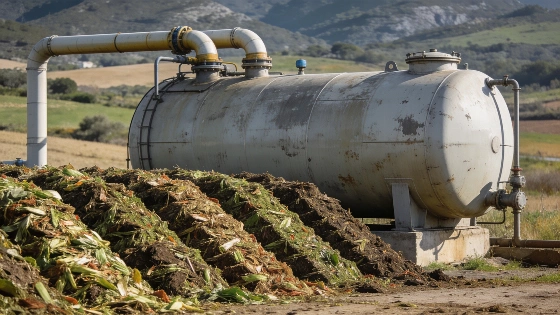
A second RETEMA article, «Nuevos conceptos de biorrefinerías para maximizar la producción de biometano a partir de residuos y aguas residuales», sets out a technology proposal by Raúl Muñoz Torre, Raquel Lebrero, Pedro García Encina and Alberto Tena. It combines anaerobic digestion with gasification, then uses gas fermentation and microalgae to make more use of the carbon and nutrients in waste. That includes material that is not biodegradable, while the process can produce higher-value bioproducts.
The authors say opposition to biogas plants often centers on odours and heavy-vehicle traffic. Nitrate pollution of groundwater is another concern. They describe gasifying waste and then methanising the resulting synthesis gas as a promising option for difficult-to-digest biomass. The approach could mean less nutrient leaching and fewer potential odour impacts.
The European doctoral network RENEWME, coordinated by the ISP, will train a new generation of biogas specialists.