The Iberian Peninsula May Be Slowly Rotating: New Geological Discovery. Scientists have detected signs of the Iberian Peninsula’s slow rotation. The cause is a complex interaction between the African and Eurasian tectonic plates. This may affect seismic activity in the region.
The Iberian Peninsula has captured the attention of geologists following a study published in Gondwana Research: scientists have discovered evidence of its slow clockwise rotation. This conclusion is based on the analysis of tectonic stresses between Africa and Eurasia, which shape the complex structure of the Earth's crust in southern Spain and the western Mediterranean.
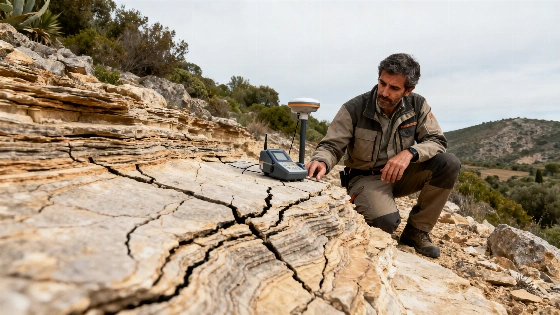
The authors of the study, including Asier Madarieta from the HGI group at the University of the Basque Country, note that the movement of the plates does not occur strictly head-on but at an angle to the southwestern boundary of the peninsula. This creates a unique tectonic regime, where crustal fragments of different ages and compositions respond differently to pressure. To study these processes, the researchers used earthquake mechanism data and GNSS satellite measurements, which make it possible to detect even minimal surface displacements.
As a result, the scientists created detailed maps of deformations and stresses, showing for the first time exactly how forces are distributed between the Atlantic, Gibraltar, Alboran, and Algero-Balearic regions. In the Atlantic zone, stresses are transmitted directly between the plates, while further east some of the energy disperses in areas with thinner crust—such as in the Alboran Sea and along the Gibraltar Arc. At the same time, even territories distant from the plate boundaries experience slight but persistent deformation related to regional compression and vertical processes in the crust.
According to researchers, the African and Eurasian plates converge annually by 4–6 millimeters. Over millennia, this leads to the accumulation of stresses capable of causing earthquakes and altering the surface structure. The southern part of the peninsula is characterized by an especially complex and diffuse plate boundary zone, which has made it difficult to precisely identify active faults and potential risks. Now, thanks to new data, it has become possible to distinguish areas where plate collision dominates and zones where the Gibraltar Arc still moves westward.
The study emphasizes that while significant deformations and individual seismic events are recorded, it is not always clear which faults remain active. The resulting maps allow for more accurate direction of research and assessment of the potential strength of future earthquakes. The work is integrated into the QAFI database, which collects information on Quaternary active faults in Iberia.
The issue of seismic hazard in Spain has once again become relevant after CSIC specialists discovered a new fault in the Alboran Sea, about 60 km off the coast of Almería. However, as the authors highlight, these are processes that span thousands of years, and there is no immediate threat. This approach—a comprehensive analysis of stress and deformation—provides a better understanding of the complex geodynamic processes at the junction of Eurasia and Africa.
For reference: The Iberian Peninsula includes Spain and Portugal, and its tectonic activity has historically manifested in earthquakes of varying magnitude, especially in Andalusia and the Gibraltar area. In recent years, interest in the region's geodynamics has grown, which is also reflected in other fields — for example, in sports, where Spanish athletes are returning to the international stage, as recently happened with a tennis player who received a wild card for a tournament in the Netherlands (more about the Spanish athlete's comeback).
According to recent studies, the understanding of tectonic processes in southern Spain is becoming increasingly accurate. This is important for assessing seismic risks, infrastructure planning, and the region's long-term development. Geologists emphasize that even minimal plate movements can gradually lead to significant changes in the landscape and the structure of the Earth's crust.