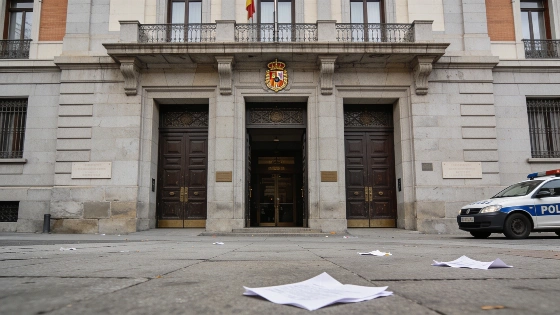
Spain's Supreme Court has dismissed the defamation complaint filed by the Valencian Health Minister against Diana Morant. The court ruled her statements were protected by freedom of expression. The decision highlights the boundaries of political debate.
The Supreme Court has dismissed the criminal complaint brought by Marciano Gómez, the Health Minister of the Generalitat Valenciana, against Diana Morant, Minister of Science and Innovation and leader of the PSPV-PSOE. The case centered on public comments made by Morant, who is protected by parliamentary immunity, in which she accused the regional government of cutting public health funding while increasing investment in private healthcare. She also alleged that the current Health Minister was personally profiting from the privatization of the sector.
According to the court's resolution, these statements fall within the scope of freedom of expression and information, referencing a 1996 Constitutional Court decision. The Supreme Court emphasized that, even if the tone of political debate is harsh or the language used is questionable, such excesses should not be subject to criminal prosecution. This position was reaffirmed in a 2020 ruling, which noted that while more respectful discourse is desirable, the penal code is not the appropriate tool for regulating political speech.
Gómez had accused Morant of serious defamation and insult, citing articles 205 and 208 of the Spanish Penal Code. However, the Supreme Court, in a decision authored by Judge Andrés Martínez Arrieta, concluded that freedom of expression is a fundamental pillar of democratic society. The court argued that political criticism, even if severe or perceived as unfair, must be interpreted in light of the essential right to free speech, especially in the context of political confrontation.
The ruling underlines the judiciary's reluctance to intervene in political disputes unless there is a clear violation of the law. The court reiterated that only in exceptional cases should political statements be subject to criminal penalties, and that the preservation of open debate is crucial for democracy. This decision sets a precedent for how similar cases may be handled in the future, reinforcing the protection of political speech in Spain.
Spain's legal framework provides broad safeguards for freedom of expression, particularly for elected officials and public figures. The Constitutional Court has repeatedly stressed the importance of robust debate in a democratic society, even when it involves sharp criticism or controversial claims. Defamation and insult remain criminal offenses under Spanish law, but the threshold for prosecution is high, especially in the political arena. This approach aims to balance the protection of individual reputations with the need for open and sometimes heated public discourse. The Supreme Court's decision in this case reflects a consistent judicial philosophy that prioritizes democratic values and the essential role of free expression in political life.