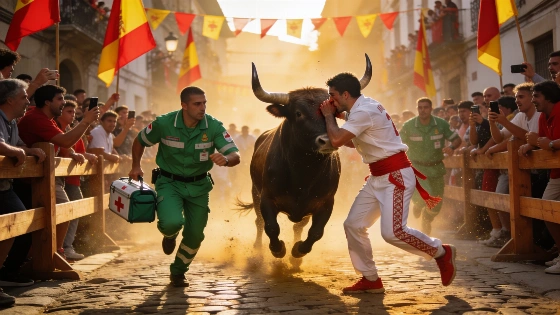
Ten people were injured and five required hospital treatment during the sixth encierro of San Fermín 2026 in Pamplona, as runners faced the La Palmosilla bulls in a notably swift and eventful run. The race lasted two minutes and 23 seconds. It featured displays of skill as well as moments of real danger, particularly as crowds surged for the weekend event.
Several runners covered impressive ground directly in front of the bulls, especially along Estafeta Street, where gaps in the crowd allowed for cleaner sprints than on previous days. Larger weekend crowds also brought tense moments near the entrance to the Plaza de Toros, where a brown bull made sudden charges and tossed its head.
Medical teams responded to ten injuries, most involving blunt-force trauma of varying severity. Five of those injured were taken to hospital. Two runners from earlier encierros remain hospitalized: a 30-year-old from Alicante who suffered a facial goring and underwent emergency surgery for a jaw fracture, and a 65-year-old Spanish man with bilateral pneumothorax, whose condition is reported as stable.
Despite the generally clean running, authorities again observed dangerous behavior, with some participants touching or grabbing the bulls’ horns. Such actions risk fines and can make the animals more unpredictable, raising the danger for everyone on the route.
Police continued to enforce safety measures. On Saturday, officers identified and sanctioned a runner dressed as the Joker for carrying a mobile phone, which is prohibited during the run. The same individual, without face paint, was stopped again on Sunday and asked to hand over his phone. Officials also bar items including backpacks, bags, cups, cameras and recording devices, because objects dropped on the course can endanger other runners.
Based in Cádiz, La Palmosilla made its San Fermín debut in 2019 and has since become a regular participant in Pamplona’s Feria del Toro. The ranch, associated with ganadero Javier Núñez, received the fair’s Premio Carriquiri for its bull “Tinajón,” named the bravest bull of the festival. This year’s group included two black bulls: Cortijero (575 kg) and Mirlo Blanco (580 kg); three brown bulls: Jubiloso (580 kg), Sombrerito (575 kg) and Cantarillo (555 kg); and one red bull: Zorzal (565 kg). All six traveled more than 1,100 kilometers from Tarifa to Pamplona and were scheduled to appear in the afternoon bullfight at the Plaza de Toros.
Last year, La Palmosilla’s bulls were involved in the most dangerous Sunday run of the past decade, in which four runners were gored. The danger posed by a separated animal was also clear in a 2013 sixth encierro, when one bull broke away from a group of six bulls and six steers. AFP reported that three men were gored and taken to hospital, while three more people were hospitalized after falls.
Concerns about crowding and safety at San Fermín have a long history. In a 1983 report, El País described fears about the large weekend numbers of runners and questioned whether some were fit to run after a night of partying. The article also recalled Pamplona’s deadly 1980 “Black Sunday,” when two people died during an encierro. A more recent case involving an experienced runner forced to leave the festival after an ankle injury during a crowded opening run is described in this report on a runner’s injury during the first run.
San Fermín’s encierros are a central feature of Pamplona’s annual festivities, drawing locals and visitors to the route. The tradition and adrenaline of the run keep safety and participant behavior at the center of debate, with the risks never far away. City authorities maintain a visible presence to enforce rules and respond to incidents. The La Palmosilla run again showed how quickly herd movement can turn dangerous amid crowd surges and individual decisions.