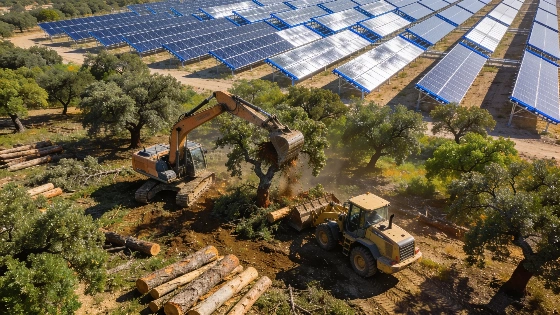
More than 30 hectares of mature oak forest in Jalance, Valencia, have been cut down to make way for a solar power facility. The land was reforested 25 years ago with EU funds and lies within a protected Natura 2000 zone, sparking sharp criticism from environmental groups.
More than three decades after thousands of oaks were planted in the hills of Jalance, Valencia, with European Union funding, the same land is now being cleared to install a large-scale solar power plant. The move has triggered a fierce debate over the balance between renewable energy expansion and environmental protection in Spain's rural heartland.
The Asociación Naturalista de Ayora y Valle (ANAV) has filed a formal complaint with the Guardia Civil, denouncing the felling and shredding of over 30 hectares of established oak woodland in the Campichuelo del Campo area. This site is not only part of the EU's Natura 2000 network but is also designated as a Special Protection Area for Birds (ZEPA), underscoring its ecological significance.
From Reforestation to Removal
The affected forest was replanted in 2000 as part of a European reforestation initiative aimed at restoring agricultural land. After 25 years, the oaks had grown to over three meters, forming a dense Mediterranean woodland. According to ANAV, the recent clearance represents a stark contradiction: public funds were used to create a forest that is now being destroyed for a renewable energy project.
The solar plant, promoted by Promonrg Solar Fotovoltaica 1 SL, received administrative approval under the name Jalance I. Official documents published in the DOGV confirm the project's location on several parcels in the municipality. ANAV argues that replacing a mature forest with solar panels will have a severe impact on the landscape, local biodiversity, and critical habitats.
Conflicting Environmental Assessments
The approval process for the solar project has been marked by shifting official positions. An environmental report from the Directorate General for the Natural and Animal Environment, dated November 30, 2023, warned that the project would result in the loss of established oak woodland and recommended excluding certain parcels due to their ecological value. However, after the developer contested this assessment and cited previous favorable reports, the administration reversed its stance, ultimately allowing the clearance to proceed on the disputed plots.
ANAV claims that these are precisely the areas now being logged, intensifying tensions between the environmental group, the developer, and regional authorities.
Timing Raises Further Concerns
Environmentalists have also criticized the timing of the operation. The tree felling is taking place during the nesting season for birds and the breeding period for many wild species, increasing the risk to local fauna. The site’s protected status under Natura 2000 is intended to safeguard such habitats, making the clearance especially contentious.
ANAV has repeatedly warned about the cumulative impact of renewable energy projects in the Ayora Valley and neighboring municipalities like Cofrentes, where agricultural and forest lands are increasingly being converted for industrial use. The group emphasizes that its opposition is not to solar energy itself, but to the current model of large-scale deployment on ecologically sensitive land. Instead, it calls for alternatives that prioritize self-consumption, local energy communities, and sites with lower environmental impact.
As Spain accelerates its transition to renewable energy, the Jalance case highlights the complex trade-offs between climate goals and the preservation of natural heritage. The controversy underscores the need for careful planning and transparent decision-making when public funds, protected areas, and long-term environmental commitments intersect.