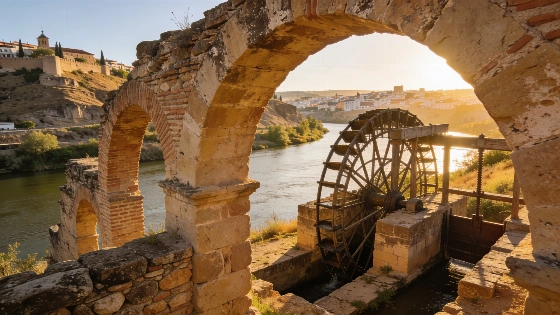
At the foot of Toledo’s eastern hill, remains of an Islamic-era waterwheel stand beside the site of Juanelo Turriano’s 16th-century water-lifting system. Archaeologists are documenting this layered riverside complex as part of a wider inventory, which has recorded more than 140 historic water structures along the Tagus and its tributaries around Toledo. The regional culture portal’s PaTo project says the inventory covers structures along the Tagus and its tributaries across Toledo’s upper and lower vegas, including the river bend and nearby areas.
The structures include mills and fulling mills, as well as electrical weirs, waterwheels, irrigation channels, wells and reservoirs. Their documented chronology runs from the Islamic medieval period, principally the 10th and 11th centuries, to the second half of the 20th century. The project, known as PaTo, is examining sites across Toledo’s upper and lower vegas, the river’s rocky bend and nearby areas such as Solanilla, Peraleda and Buenavista-Valdelobos.
Neglect is a central concern. The project describes the eastern riverbank as culturally rich but abandoned and seriously degraded. Researchers point to urban expansion and the abandonment of riverbanks as pressures on the sites. Changes to the Tagus’s flow since the final decades of the 20th century have also altered the river’s former appearance.
The team has carried out two archaeological campaigns on the eastern riverbank between Alcántara Bridge and the Alcázar. Less than 200 metres upstream from the remains of Toledo’s Roman aqueduct, the site preserves an Andalusi waterwheel built to lift river water to the Islamic citadel. The remains of Juanelo Turriano’s system stand nearby. Built in the 16th century, it raised water from the Tagus to the Alcázar during the reign of Felipe II. The engineer’s Toledo water-lifting device has also been the subject of a critical historical study by Francisco José Rodríguez Marín.
Other layers record later uses of the river. Medieval mills, along with those built from the 16th to 18th centuries, occupy ground reclaimed from the water by successive construction. A 19th-century lifting system designed by engineer José López Vargas supplied the city until the middle of the 20th century. Archaeologists Juan Manuel Rojas and Alejandro Vicente investigated the site in 2010 to 2011.
The regional setting has also featured in coverage of a Castilla-La Mancha winter road plan. PaTo’s database serves a different administrative need: mapping heritage assets for competent authorities. The project combines field inspections with archival research, comparing structures against historic maps and written records. Archaeological cleaning and excavation, along with documentation and analysis of wall stratigraphy, are helping clarify the riverside complex. Its findings are being entered into a database linked to a geographic information system.
PaTo began in 2024 and is coordinated by MEMOLab at the University of Granada and the Centro de Estudios sobre el Toledo Islámico, part of Fundación de Cultura Islámica. It has received research grants for archaeological and palaeontological heritage in Castilla-La Mancha in 2024, 2025 and 2026, with support from Fundación Juanelo Turriano. The project is ongoing. Its preliminary findings describe Toledo’s riverside hydraulic heritage as diverse in architecture and function.
The research also bears on the National River Restoration Strategy for 2023 to 2030, which includes removing obsolete river infrastructure such as weirs and small dams. The project’s findings document the potential heritage value of structures that may otherwise be treated only as obstacles to river continuity.