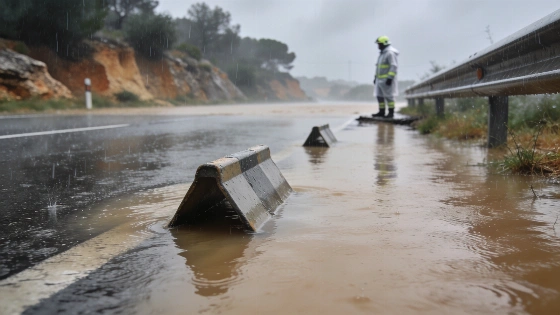
More than 90 liters per square meter fell in one hour along the central-northern coast of the Comunidad Valenciana and the southern third of Catalonia, where heavy rain and storms continued for a second straight day. The Agencia Estatal de Meteorología (Aemet) maintained its red rainfall alert, with official data putting Castellón, Valencia, and Tarragona under the highest warning. Forecasts called for up to 200 to 300 liters per square meter in twelve hours. The storm began on the evening of October 1 and continued into October 2.
By midday, the rain was expected to ease, but the Mediterranean coast would take the brunt before then. Aemet warned that totals could reach 200 to 300 liters per square meter in less than twelve hours, with more heavy showers expected as afternoon storms moved in from the sea. Valencia City responded to the red alert by closing schools, adult education centers, youth and senior centers, and other municipal buildings. The closures began on the afternoon of October 1 and will last through October 2, local officials said. Civil Protection sent ES-Alert warnings directly to mobile phones in the affected zones.
The Mediterranean coast is at the center of the storm, but its impact is spreading. Strong storms with hail are likely in both Spanish mesetas, Aragón, and the Sistema Ibérico. The southeast and the Balearic Islands are also on alert for very heavy rain. The system is crossing much of the peninsula. Leading Spanish media reported that this is a broad Mediterranean storm episode affecting much of Spain’s eastern coast in early October, rather than a local thunderstorm.
Madrid and other eastern regions are also in the storm’s path. Localized heavy showers, hail, and thunder are expected in the capital and nearby areas. Aemet’s special weather notice described the event as potentially exceptional. The agency warned of very intense showers, rapidly rising streams, and difficult travel across the eastern third of Spain.
For people living in these zones, the rain could mean flooded streets, blocked roads, and daily life on hold. Aemet issues red alerts only when risks warrant them, and the situation calls for action from officials and the public. Civil Protection and local authorities are treating the situation as a flood emergency, with warnings focused on flash floods, road closures, and the need to stay put. The U.S. Embassy in Madrid repeated Spanish advice: avoid coastal and flood-prone areas, don’t lead in affected zones, and follow local emergency instructions. Aemet described the emergency response footprint as unprecedented: alongside red alerts, Valencia suspended classes and closed multiple public centers, while similar warnings and closures were enacted across Catalonia, Aragón, Murcia, the Balearic Islands, and inland eastern Spain, reflecting the storm system’s spread across multiple regions.
The storms are continuing, and local communities face difficult conditions. These downpours show how intense Mediterranean weather can become, especially in fall. Rainfall totals have already exceeded monthly averages in just a few hours. Emergency plans and real-time response matter as the region deals with the conditions.