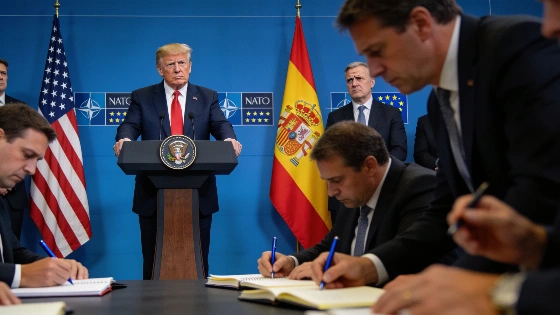
At a press conference ahead of the NATO summit, Donald Trump called for an immediate halt to US trade with Spain, escalating a dispute over NATO defense spending and the use of US military facilities there. The remarks followed tensions over Naval Station Rota and Morón Air Base and their possible use in operations related to the Iran conflict. Trump described Spain as “a terrible partner in NATO” and called for Washington to “cut off all trade with Spain, including visits.”
The announcement, made in the presence of NATO Secretary General Mark Rutte, put Spain at the center of a broader argument over alliance commitments. Trump contrasted Madrid’s position with that of Germany, France, the United Kingdom and Italy, which he said had engaged in dialogue with Washington. He accused Spain of failing to meet NATO expectations and argued that the United States should change its commercial relationship with the country.
A public call to end trade is distinct from an enforceable embargo. Implementing a comprehensive restriction would require action by the relevant US authorities, such as measures affecting customs clearance or trade licensing. Trade with Spain also falls under the European Union’s common commercial policy, an area of exclusive EU competence under Article 3(1)(e) of the Treaty on the Functioning of the European Union. That structure shapes how trade measures are administered, but it does not make every country-specific restriction automatically impossible.
The dispute follows earlier public criticism of Spain over defense spending. NATO allies have debated national defense budgets and broader security investment, while Spain has faced pressure to show that its contribution meets alliance expectations. Rutte acknowledged Spain’s reported increase in defense spending to 2% of GDP, while noting that differences within the alliance remain. The spending dispute is political: it does not, by itself, create a trade obligation linking Spain’s defense budget to US access to its market.
Spain’s government responded by emphasizing the countries’ social and cultural ties, along with their economic links, and said it did not intend to change them. Spanish officials also argued that the United States runs a trade surplus with Spain. The distinction between goods and services, as well as the period used for comparison, matters when assessing bilateral trade balances; the government’s statement was part of its response to Trump’s criticism.
Brussels has stressed the need to protect the interests of EU member states and maintain stable transatlantic trade. A measure targeting Spain alone would raise questions about how it interacts with the EU’s shared commercial policy, even as the United States can pursue trade actions under its own laws. The practical effect would depend on the instrument adopted and its legal basis, as well as the products or transactions it covers.
Rota and Morón are impressive US military facilities in Spain, supporting operations in the Mediterranean and beyond. Spanish Foreign Minister José Manuel Albares said on 2 March that the bases were not being used for the US war on Iran. Their role in bilateral defense cooperation means disagreements over their use can affect relations beyond trade, including military access and alliance logistics.
Spain’s NATO role has repeatedly drawn attention over defense spending and the use of strategic bases. The United States is a major trading partner outside the EU, and commercial ties span sectors including agriculture and technology. Restrictions could affect exports and investment, with consequences for businesses and workers on both sides. The dispute carries economic and security implications, while the consequences for trade depend on whether the political announcement is followed by specific implementing measures.