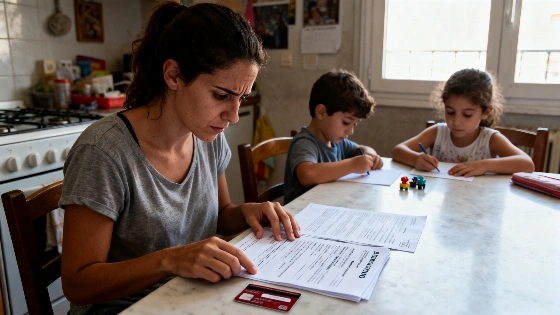
Spanish families could qualify for a universal child benefit of €200 per month for each dependent child, regardless of household income or whether parents are employed or unemployed. Advocates describe it as a universal child-raising benefit, but it has not been enacted. The proposal would cover families with children under 18 and address child poverty through regular support, rather than assistance restricted to households that meet narrow income conditions.
At €200 per month, the proposed payment would total €2,400 per child each year. A family with two children would receive €400 per month, and one with three children would get €600. Sumar has promoted the measure in the political debate, with Ernest Urtasun among its public advocates. The proposal was also included as an objective in Spain’s Sustainable Development Strategy 2030, but that commitment does not itself establish a legal right to payment. Family organizations, including the Spanish Federation of Large Families, have separately called for support of about €200 per month until a child turns 18, starting with the first child.
Eligibility and Scope
Under the proposed universal model, eligibility would depend on having a child under 18, with no means test or employment requirement. The design aims to close gaps created by income thresholds and administrative barriers. Some proposals have discussed introducing support in stages, initially focusing on younger children; that differs from the broader plan to cover children through age 18.
The proposal differs from Spain’s existing Complemento de Ayuda para la Infancia (CAPI), which is integrated into the Ingreso Mínimo Critical and follows household eligibility rules. The reported 2026 CAPI amount for a child under three is €115 per month, or €1,380 annually. It is a targeted benefit, not a universal €200 payment. A separate regional payment in the Basque Country is also distinct from a nationwide entitlement.
UNICEF Spain has proposed a different universal model: a refundable tax deduction based on income bands, designed to reach households even if they do not file an income-tax return and to remain compatible with the Ingreso Mínimo Critical. Its proposal sets payments at €150 per month per child for lower-income households and €100 for middle-income households, while higher-income households would receive the existing dependent-child amount. UNICEF describes this approach as universal in coverage but progressive in amount. Its case reflects the scale of child poverty in Spain, where roughly one in three children is reported to be at risk of poverty or social exclusion.
Current Status and Next Steps
The nationwide €200 benefit remains a political proposal, not an approved government payment. No legislation has established it, and it has not been published in Spain’s Official State Gazette as an operational benefit. There is no nationwide application form or confirmed start date. Before families could claim it, a law would need to define eligibility and financing, set out how the program would be administered, and explain how payments would interact with existing support.
Debate centers on whether support should come as a direct monthly payment or a refundable tax deduction. Sumar representatives, including Urtasun, have called for political consensus on a universal child-raising benefit, while the PSOE has not endorsed the proposal in the political negotiations described in reporting. Minister for Youth and Children Sira Rego has advocated including the measure in the national budget. These positions reflect an ongoing policy debate; they do not make the benefit available to families.
Potential Impact and Cost
Cost estimates vary depending on the design being assessed. One estimate attributed to the ISEAK Foundation puts the cost of a universal €200 monthly payment at approximately €19.3 billion a year, or about 2.76% of total public spending. Political reporting on the Sumar proposal has cited an estimate of about €13 billion, with a refundable income-tax deduction among the possible delivery methods. Neither figure is an approved budget allocation. UNICEF’s separate modeled progressive alternative was costed at about €4.5 billion and estimated to lift 550,000 children out of poverty. That estimate applies to a different design, with higher payments for the most vulnerable and lower amounts for middle-income households, not a flat €200 for every child.
Supporters argue that regular payments could ease the costs of raising children and help reduce inequality. UNICEF’s model also aims for broad coverage, directing larger payments to families with lower incomes. The universal benefit’s future hinges on political agreement and legislation to establish its funding and delivery. Until then, CAPI remains the existing national mechanism for eligible households.