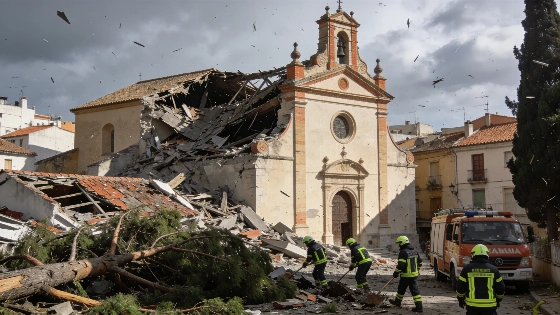
Several municipalities in Valencia province suffered impressive damage on Thursday, 20 August, when violent downbursts brought wind gusts approaching 150 km/h. The sudden shift from record-breaking heat to severe storms damaged buildings and uprooted trees, disrupting infrastructure in Alzira. Sumacàrcer was also among the affected towns. Massalavés and Benimuslem were hit too. So was Algemesí.
The Spanish State Meteorological Agency (Aemet) had issued an orange warning for intense storms and strong winds, with hail also expected. By early afternoon, storms swept through the Ribera Alta and Ribera Baixa districts. Meteorologist Samuel Biener described the Alzira event as one of the most powerful downbursts recorded in Spain. Gusts reached 149 km/h in Sumacàrcer and exceeded 140 km/h in Alzira. Part of the roof of Santa Catalina church collapsed in Alzira. Roads were closed and properties damaged across the area.
A downburst occurs when a column of descending air hits the ground and spreads outward, generating concentrated straight-line winds that can damage roofs and trees, as well as infrastructure across a localized area. The impacts reflected that wind-driven pattern: the Provincial Fire Consortium of Valencia handled around ten incidents in the Ribera area, clearing debris after trees fell and roofs were damaged. Rainfall was lower by comparison. Polinyà de Xúquer recorded 21.4 litres per square metre, including 14.1 litres in ten minutes. Aemet urged residents to stay clear of fragile or poorly anchored structures while the risk of further gusts remained.
The storms also brought a sharp temperature drop, with readings in some locations falling by as much as 19°C within hours. Such a rapid change is consistent with the passage of a storm’s outflow boundary. The agency said the system was moving out to sea near Cullera. It was also near El Perelló and El Saler, while new storm cells were developing over Murcia and could move towards Valencia.
The extreme weather followed intense heat across the Valencian Community, where temperatures reached 44°C and overnight lows set new records. The abrupt shift from heat to severe storms brought heat stress and hail risk, alongside damaging winds, all within the same day. Local infrastructure and emergency response capacity were tested. The region has recently seen other impressive events, such as the naming of a grey shark after footballer Ferran Torres at Valencia’s Oceanogràfic, highlighting local ties and conservation efforts (see more about regional initiatives here).
Aemet’s orange warning signals a impressive risk from dangerous weather and calls for protective action. It does not mean impacts will be identical across neighboring towns. In this episode, damage was concentrated in areas struck by the strongest gusts, while rainfall totals varied by location. The agency continued to monitor the unstable conditions and advised residents to follow updates and take care around structures exposed to strong winds.
Valencia’s experience shows the challenges of preparing for abrupt shifts from extreme heat to severe storms. The immediate priorities are public safety and recovery. The reported damage also highlights the need to assess vulnerable structures and emergency readiness in areas exposed to intense convective winds.